A Level Economics (9708)•9708/13/O/N/24
A Level Economics (9708) — 9708/13/O/N/24, Question 22
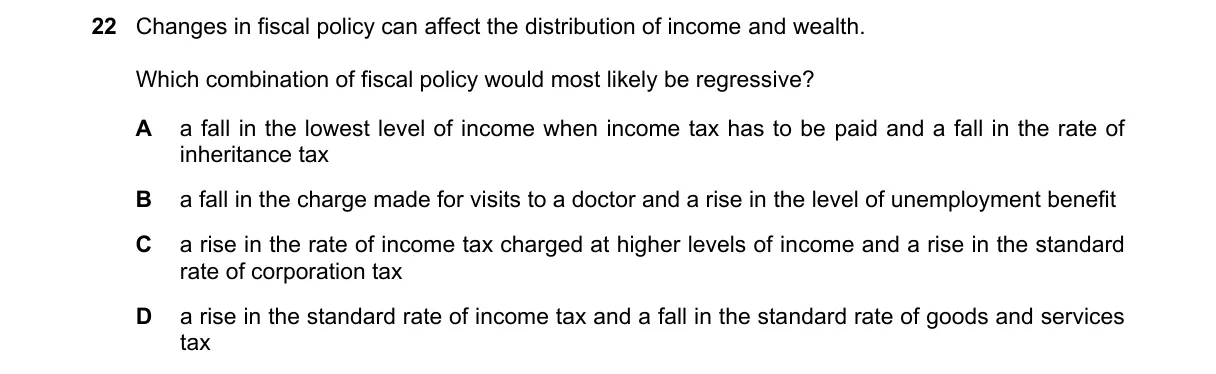
Changes in fiscal policy can affect the distribution of income and wealth. Which combination of fiscal policy would most likely be regressive?
Answer choices
- Aa fall in the lowest level of income when income tax is to be paid and a fall in the rate of corporation tax
- Ba rise in the rate of income tax charged at higher levels of income and a standard rate of corporation tax
- Ca fall in the charge for visits to a doctor and a rise in the level of unemployment benefit
- Da rise in the standard rate of income tax and a fall in the standard rate of goods and services tax
Explanation
Regressive fiscal policy burdens low-income groups more
Steps:
- Define regressive policy: Taxes or changes that take higher income proportion from the poor than the rich.
- Analyze A: Lowers tax threshold, forcing low earners to pay income tax sooner; cuts corp tax, benefiting wealthy shareholders.
- Analyze B, C, D: Check if they favor high earners or aid the poor.
- Select most regressive: Option disproportionately hits low incomes.
Why A is correct:
- Lowers personal allowance, making income tax more regressive by taxing low earners' income at basic rate; corp tax cut shifts burden to workers per incidence theory.
Why the others are wrong:
- B: Higher progressive tax on rich reduces inequality.
- C: Subsidizes healthcare and boosts benefits for low-income/unemployed, progressive.
- D: Raises income tax (progressive) and cuts GST (less regressive overall).
Final answer: A
Topic: Fiscal policy
Practice more A Level Economics (9708) questions on mMCQ.me