A Level Economics (9708)•9708/13/O/N/24
A Level Economics (9708) — 9708/13/O/N/24, Question 19
A government is considering building a hospital. The impact on the country's price level will depend partly on the amount of expensive raw materials the country imports for the hospital and the level of unemployment in the country. Which combination of imports of materials for the hospital and the level of unemployment is most likely to lead to the largest rise in price?
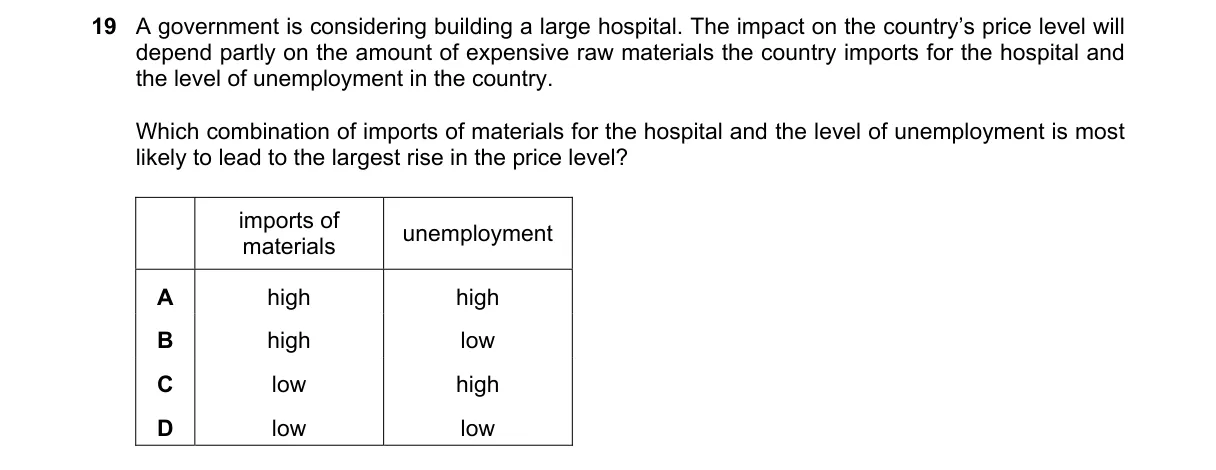
Answer choices
- Ahigh materials, high unemployment
- Blow materials, high unemployment
- Chigh materials, low unemployment
- Dlow materials, low unemployment
Explanation
Inflation from domestic spending near full employment
Steps:
- Government spending on the hospital boosts aggregate demand (AD).
- High imports of materials cause spending leakage abroad, reducing net domestic AD increase; low imports maximize domestic impact.
- High unemployment signals economic slack with a flat short-run aggregate supply (AS) curve, allowing output growth with minimal price pressure.
- Low unemployment means the economy is near capacity with a steep AS curve, amplifying price effects from AD shifts.
Why D is correct:
- In the AD-AS model, low imports ensure a large AD shift while low unemployment positions the economy on the steep AS portion, where output can't expand much, forcing the biggest price level rise per the Phillips curve trade-off.
Why the others are wrong:
- A: High imports shrink net AD; high unemployment flattens AS for small price rise.
- B: Low imports boost AD, but high unemployment flattens AS, limiting price rise.
- C: Low unemployment steepens AS, but high imports shrink net AD, muting inflation.
Final answer: D
Topic: Aggregate Demand and Aggregate Supply analysis
Practice more A Level Economics (9708) questions on mMCQ.me