A Level Economics (9708)•9708/12/O/N/24
A Level Economics (9708) — 9708/12/O/N/24, Question 25
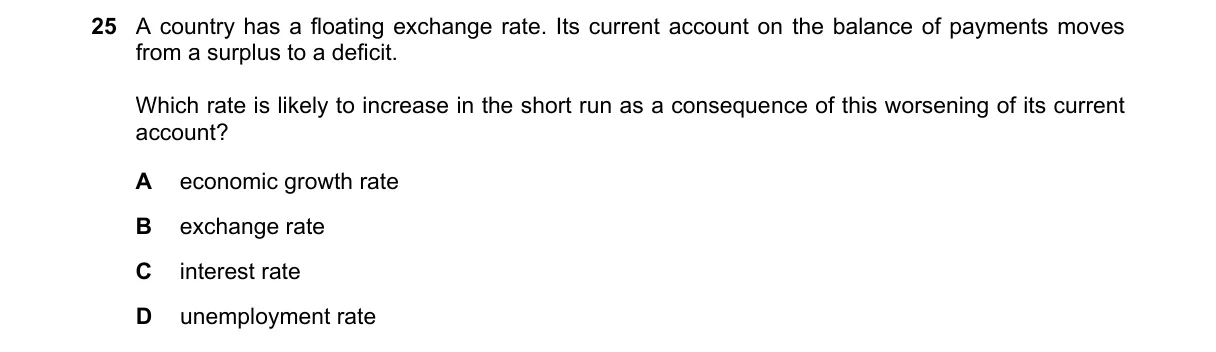
A country has a floating exchange rate. Its current account on the balance of payments moves from a surplus to a deficit. Which rate is likely to increase in the short run as a consequence of this worsening of its current account?
Answer choices
- Aeconomic growth rate
- Bexchange rate
- Cinterest rate
- Dunemployment rate
Explanation
Current account deficit reduces aggregate demand, raising unemployment
Steps:
- Current account shifts from surplus to deficit, signaling lower net exports.
- Lower net exports decrease aggregate demand in the economy.
- In the short run, reduced aggregate demand slows output and hiring.
- This leads to higher cyclical unemployment under floating exchange rates.
Why D is correct:
- Per Okun's law, a GDP slowdown from falling net exports increases unemployment by 1% for every 2% GDP drop.
Why the others are wrong:
- A: Economic growth rate falls due to lower aggregate demand from the deficit.
- B: Exchange rate depreciates (domestic currency weakens), so its value decreases.
- C: Interest rates likely fall as central bank responds to weaker growth.
Final answer: D
Topic: Exchange rates
Practice more A Level Economics (9708) questions on mMCQ.me