A Level Economics (9708)•9708/12/O/N/24
A Level Economics (9708) — 9708/12/O/N/24, Question 2
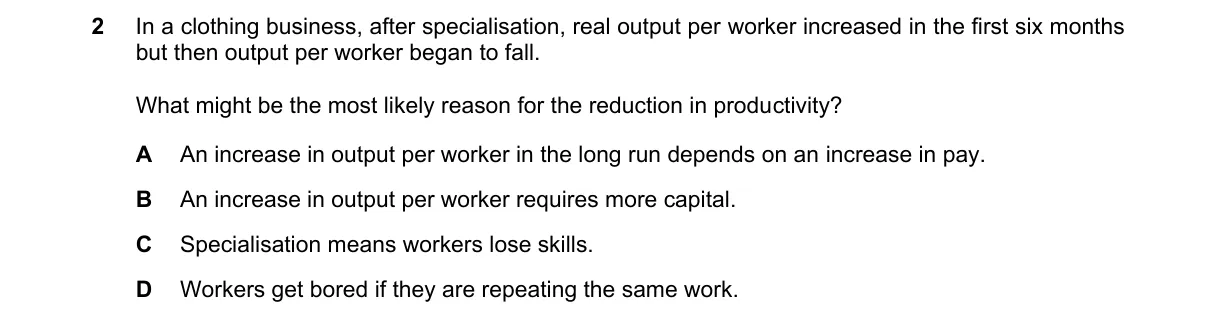
In a clothing business, after specialisation, output per worker increased in the first six months but output per worker fell in the long run. What will be the most likely reason for the reduction in productivity?
Answer choices
- AAn increase in output per worker in the long run depends on an increase in pay.
- BAn increase in output per worker requires more capital.
- CSpecialisation means workers lose skills.
- DWorkers get bored if they are repeating the same work.
Explanation
Long-run demotivation from repetitive specialization
Steps:
- Specialization initially boosts productivity through focused tasks and efficiency gains.
- Short-term output rises as workers master simple roles quickly.
- Over time, repetitive work causes boredom and reduced effort.
- This leads to long-run productivity decline despite initial improvements.
Why D is correct:
- Repetitive tasks in specialization cause worker boredom, reducing motivation and output per Adam Smith's division of labor, where overspecialization erodes enthusiasm.
Why the others are wrong:
- A: Pay increases are not required for sustained productivity; motivation issues persist regardless.
- B: Capital needs relate to production capacity, not the observed long-run worker output fall.
- C: Specialization builds specific skills, not loses them, contradicting initial productivity rise.
Final answer: D
Topic: Factors of production
Practice more A Level Economics (9708) questions on mMCQ.me