A Level Economics (9708)•9708/12/O/N/24
A Level Economics (9708) — 9708/12/O/N/24, Question 11
Good X has a substitute, good Y and a complement, good Z. The price of Y decreases and the price of Z increases. Why might the equilibrium price of X remain unchanged?
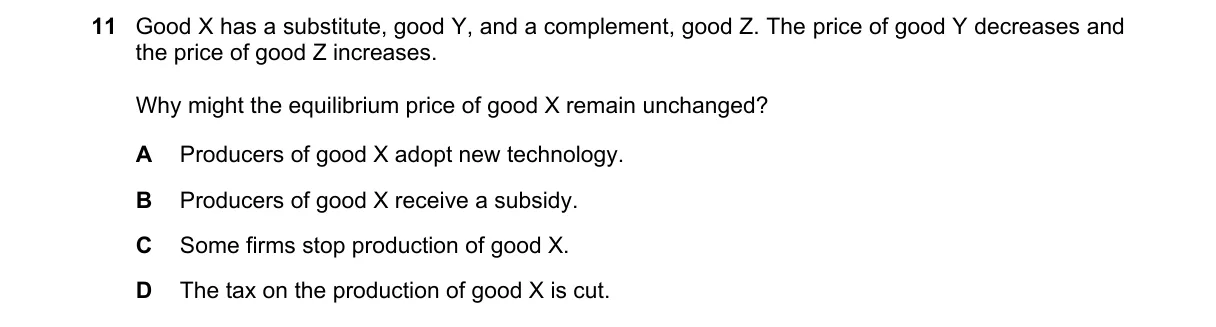
Answer choices
- AProducers of good X adopt new technology.
- BProducers of good X receive a subsidy.
- CSome firms stop production of good X.
- DThe tax on the production of good X is cut.
Explanation
Offsetting Demand and Supply Shifts
Steps:
- Price of substitute Y falls, shifting demand for X leftward and lowering its equilibrium price.
- Price of complement Z rises, shifting demand for X leftward and further lowering its equilibrium price.
- Combined demand decrease tends to reduce X's price.
- A supply decrease for X shifts its supply curve leftward, raising price and potentially offsetting the demand shift to keep equilibrium price unchanged.
Why C is correct:
- Some firms exiting production reduces X's supply (leftward shift per supply-demand equilibrium), countering the demand decrease from Y and Z price changes.
Why the others are wrong:
- A: New technology increases supply (rightward shift), amplifying the price fall.
- B: Subsidy lowers production costs, increasing supply and further reducing price.
- D: Tax cut reduces costs, increasing supply and decreasing price.
Final answer: C
Topic: The interaction of demand and supply
Practice more A Level Economics (9708) questions on mMCQ.me