A Level Economics (9708)•9708/11/O/N/24
A Level Economics (9708) — 9708/11/O/N/24, Question 22
Which combination of fiscal and monetary policies would certainly be expansionary?
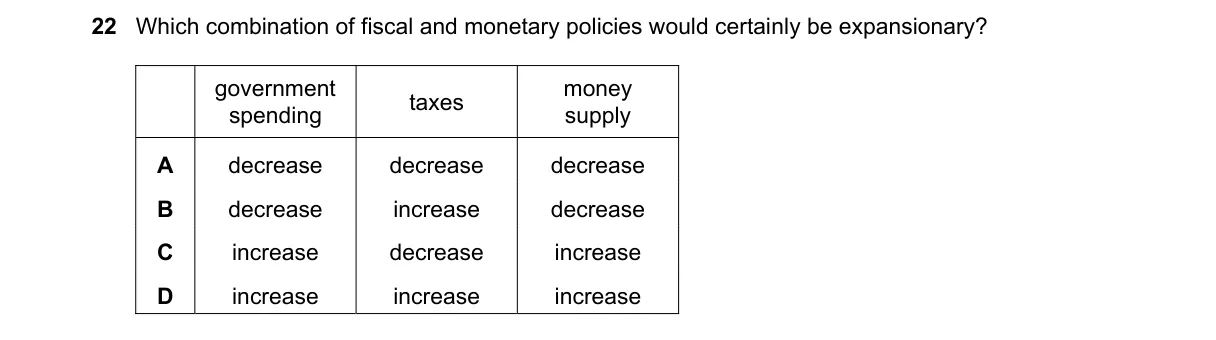
Answer choices
- Agovernment spending: decrease, taxes: increase, money supply: decrease
- Bgovernment spending: decrease, taxes: decrease, money supply: decrease
- Cgovernment spending: increase, taxes: decrease, money supply: increase
- Dgovernment spending: increase, taxes: increase, money supply: increase
Explanation
Expansionary Policies Boost Aggregate Demand
Steps:
- Recall expansionary fiscal policy increases government spending or cuts taxes to raise aggregate demand.
- Recall expansionary monetary policy increases money supply to lower interest rates and stimulate investment.
- Assess each option: expansionary fiscal requires net stimulus from spending/taxes; monetary requires money supply growth.
- Select option with all components clearly expansionary for certain overall effect.
Why C is correct:
- C features increased spending and decreased taxes (expansionary fiscal per Keynesian model) plus increased money supply (expansionary monetary via liquidity effect), guaranteeing aggregate demand rise.
Why the others are wrong:
- A: All elements—spending cut, tax hike, money supply cut—are contractionary, reducing demand.
- B: Spending and money supply cuts are contractionary, offsetting any tax cut benefit.
- D: Tax increase offsets spending rise in fiscal policy, creating ambiguous net effect despite monetary expansion.
Final answer: C
Topic: Effectiveness of policy options to meet all macroeconomic objectives
Practice more A Level Economics (9708) questions on mMCQ.me