A Level Economics (9708)•9708/11/O/N/24
A Level Economics (9708) — 9708/11/O/N/24, Question 14
The government wishes to intervene in a free market to allocate healthcare at the socially optimal level. Which combination correctly identifies the reason for government intervention in the healthcare market?
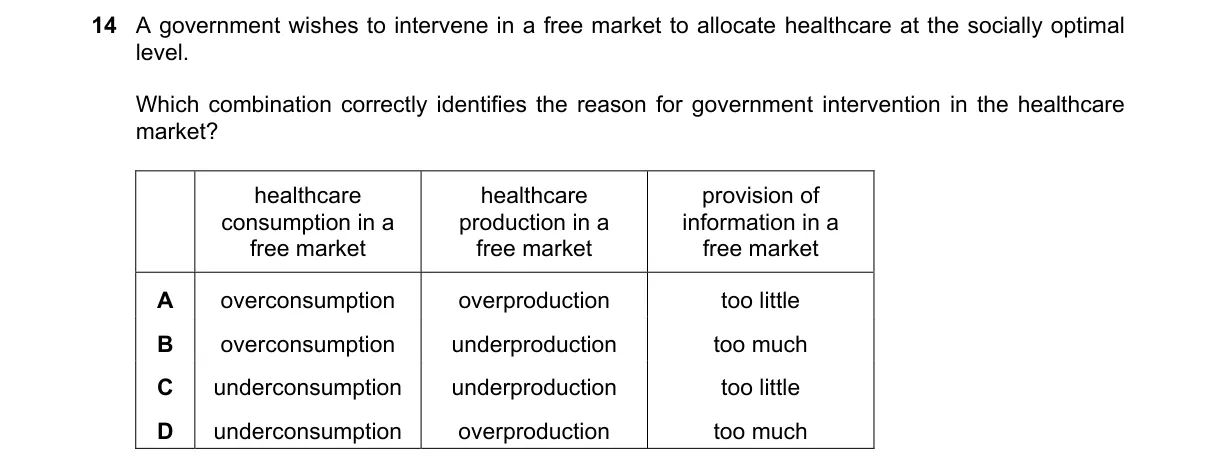
Answer choices
- Aoverconsumption in a free market, overproduction in a free market, too little provision of information in a free market
- Bunderconsumption in a free market, underproduction in a free market, too much provision of information in a free market
- Cunderconsumption in a free market, underproduction in a free market, too little provision of information in a free market
- Dunderconsumption in a free market, overproduction in a free market, too much provision of information in a free market
Explanation
Healthcare Market Failures: Externalities and Information
Steps:
- Recognize healthcare as a merit good with positive externalities, causing underproduction below social optimum.
- Note underconsumption occurs as individuals undervalue benefits, consuming less than socially optimal.
- Identify information asymmetry where providers know more than consumers, leading to too little information.
- Match these failures to option C for government intervention via subsidies or regulation.
Why C is correct:
- Healthcare exhibits positive externalities (e.g., herd immunity), so marginal social benefit exceeds private benefit, requiring intervention to correct underconsumption, underproduction, and information gaps per Pigouvian welfare economics.
Why the others are wrong:
- A: Overconsumption and overproduction apply to demerit goods like tobacco, not healthcare.
- B: Too much information contradicts asymmetric information failure in healthcare.
- D: Overproduction ignores positive externalities that cause underproduction.
Final answer: C
Topic: Reasons for government intervention in markets
Practice more A Level Economics (9708) questions on mMCQ.me