A Level Economics (9708)•9708/13/O/N/23
A Level Economics (9708) — 9708/13/O/N/23, Question 7
When incomes of consumers of X fall 5%, under which conditions will the demand curve shift furthest to the right?
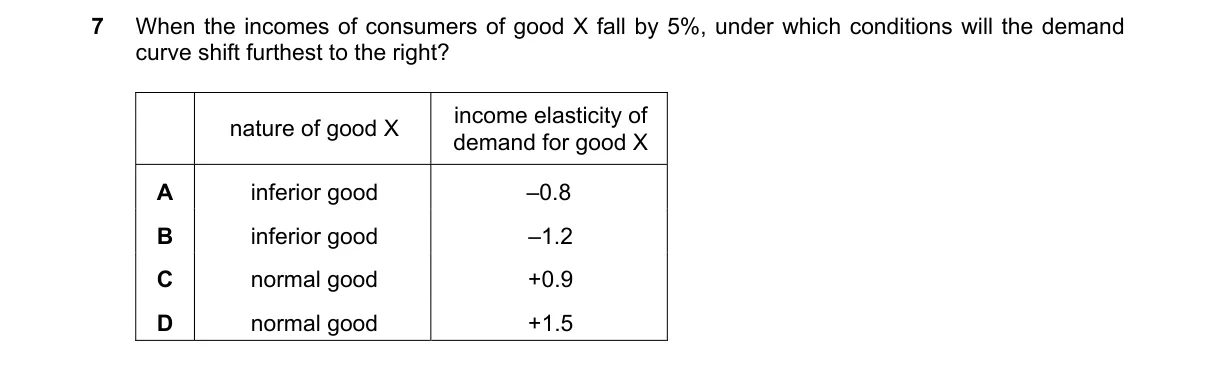
Answer choices
- AInferior good -0.8
- Binferior good -1.2
- Cnormal good +0.9
- Dnormal good +1.5
Explanation
Inferior goods shift demand right when income falls; larger |IED| amplifies shift
Steps:
- Calculate %ΔQD = IED × %Δincome (-5%) for each option.
- Inferior goods (negative IED) yield positive %ΔQD, shifting demand right.
- Normal goods (positive IED) yield negative %ΔQD, shifting demand left.
- Compare magnitudes: furthest right shift is largest positive %ΔQD.
Why B is correct:
- For inferior good with IED = -1.2, %ΔQD = (-1.2) × (-5%) = +6%, maximizing rightward shift per income elasticity formula.
Why the others are wrong:
- A: IED = -0.8 gives +4% shift, smaller than B's +6%.
- C: Normal good IED = +0.9 gives -4.5% shift (leftward).
- D: Normal good IED = +1.5 gives -7.5% shift (leftward, opposite direction).
Final answer: B
Topic: Price elasticity, income elasticity and cross elasticity of demand
Practice more A Level Economics (9708) questions on mMCQ.me