A Level Economics (9708)•9708/13/O/N/23
A Level Economics (9708) — 9708/13/O/N/23, Question 28
Which combination of initial equilibrium and supply-side policy is likely to be least effective when attempting to increase the real output of an economy?
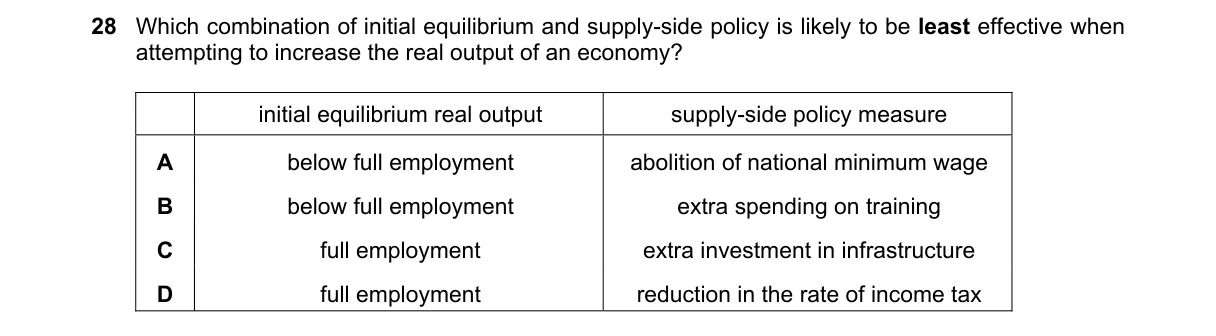
Answer choices
- Ainitial below full employment; abolition of national minimum wage
- Bbelow full employment; extra spending on training
- Cfull employment; extra investment in infrastructure
- Dfull employment; reduction in the rate of income tax
Explanation
Supply-side policies' effectiveness depends on economic slack and policy type
Steps:
- Supply-side policies shift long-run aggregate supply (LRAS) right to boost potential output.
- Below full employment, slack allows actual output to rise without inflation.
- At full employment, policies raise potential output but risk short-run inflation over output gains.
- Abolition of minimum wage lowers costs but fails to address skill or structural unemployment barriers.
Why A is correct:
- Below full employment, labor market has excess supply; abolishing minimum wage reduces wages but does not increase employment or output significantly, as per downward-sloping labor demand curve.
Why the others are wrong:
- B: Training enhances human capital and productivity, shifting AS right effectively with slack.
- C: Infrastructure investment increases capital stock and capacity, raising potential output even at full employment.
- D: Income tax reduction boosts work incentives and labor supply, enabling output growth at full employment.
Final answer: A
Topic: Supply-side policy
Practice more A Level Economics (9708) questions on mMCQ.me