A Level Economics (9708)•9708/11/O/N/23
A Level Economics (9708) — 9708/11/O/N/23, Question 28
The government of a country plans to raise income tax rates. The initial equilibrium for the country is represented by point X on the diagram. Which new equilibrium point would an economist predict as the result?
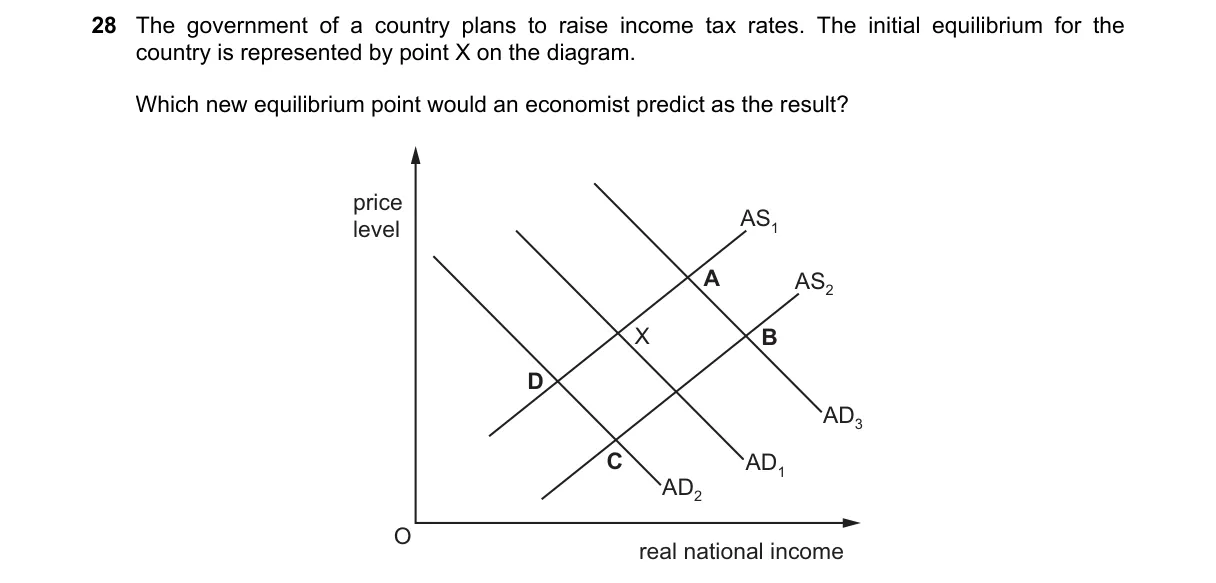
Answer choices
- AOption A
- BOption B
- COption C
- DOption D
Explanation
Increase in income taxes shifts aggregate demand leftward
Steps:
- Raising income taxes reduces households' disposable income.
- Lower disposable income decreases consumption expenditure.
- Aggregate demand curve shifts left from initial equilibrium at X.
- New equilibrium occurs at lower output and price level, corresponding to point D.
Why D is correct:
- D shows the post-shift AD-AS intersection, aligning with the Keynesian consumption function where higher taxes reduce C = c(Y - T).
Why the others are wrong:
- A: Indicates rightward AD shift, which would occur with tax cuts, not increases.
- B: Represents no change in equilibrium, ignoring the tax impact on demand.
- C: Suggests higher output but same prices, inconsistent with leftward AD shift reducing both.
Final answer: D
Topic: Fiscal policy
Practice more A Level Economics (9708) questions on mMCQ.me