A Level Economics (9708)•9708/11/O/N/23
A Level Economics (9708) — 9708/11/O/N/23, Question 24
General equilibrium in the macroeconomy is achieved when total injections are equal to total leakages. What is most likely to cause disequilibrium in the macroeconomy in the short run?
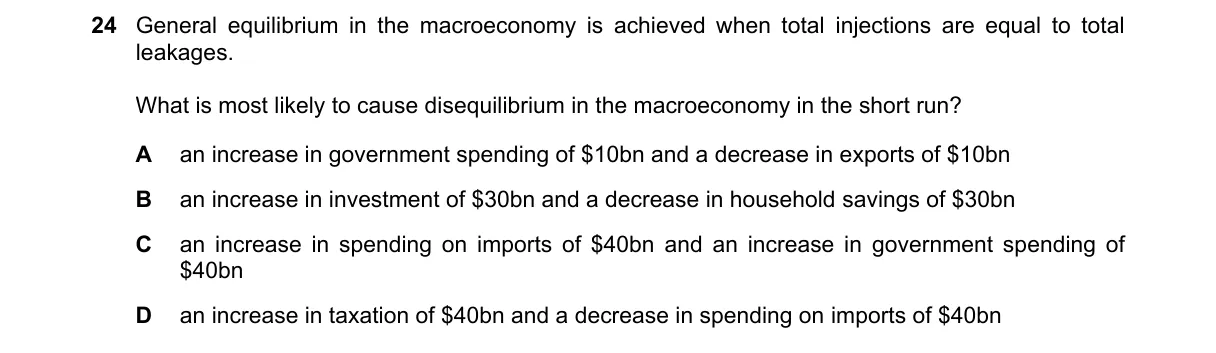
Answer choices
- Aan increase in government spending of $10bn and a decrease in exports of $10bn
- Ban increase in investment of $30bn and an increase in government spending of $30bn
- Can increase in spending on imports of $40bn and an increase in taxation of $40bn
- Dan increase in taxation of $40bn and a decrease in spending on imports of $40bn
Explanation
Net imbalance between injections and leakages causes short-run disequilibrium
Steps:
- Injections consist of investment (I), government spending (G), and exports (X); leakages consist of savings (S), taxes (T), and imports (M).
- Equilibrium requires total injections equal total leakages.
- Disequilibrium occurs when changes create an unmatched surplus or deficit in these flows.
- Evaluate each option for net effect on injections relative to leakages.
Why B is correct:
- Boosts injections by 30bn I + $30bn G) with no leakage offset, violating injection-leakage equality in the circular flow model.
Why the others are wrong:
- A: G rise (10bn injection), preserving balance.
- C: T rise (40bn leakage) and limiting net imbalance.
- D: T rise (40bn leakage), maintaining equality.
Final answer: B
Topic: The circular flow of income
Practice more A Level Economics (9708) questions on mMCQ.me