A Level Economics (9708)•9708/11/O/N/23
A Level Economics (9708) — 9708/11/O/N/23, Question 18
Four students have to fill in the gaps in the sentence shown. 'A person is unemployed if they are 1. to work at 2. wage, but cannot find a job despite an active search for work.' Which student fills gaps 1 and 2 correctly?
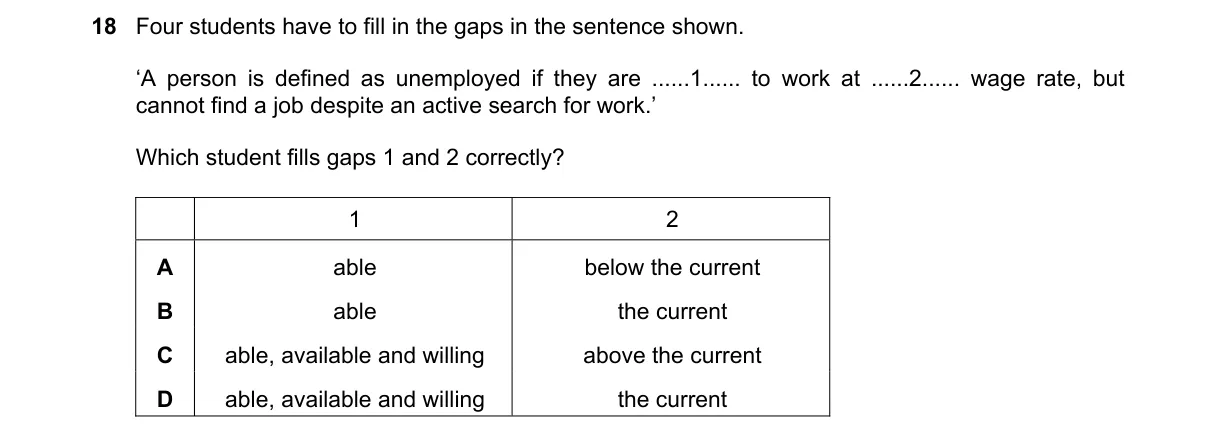
Answer choices
- Aable below current
- Bable, available and willing above the current
- Cavailable and willing the current
- Davailable, available and willing above current
Explanation
Standard Definition of Unemployment Steps:
- Identify the economic definition: A person is unemployed if jobless, actively seeking work, and available/willing to accept a job at the prevailing wage.
- Analyze gap 1: It requires adjectives describing readiness to work (available and willing).
- Analyze gap 2: It specifies the wage level (the current or market rate).
- Test options: Only one forms a coherent sentence matching the definition.
Why C is correct:
- "Available and willing to work at the current wage" aligns with the Bureau of Labor Statistics definition, emphasizing readiness at market rates despite active search.
Why the others are wrong:
- A: "Able to work at below current wage" implies acceptance of sub-market pay, not the standard criterion for unemployment measurement.
- B: "Able to work at available and willing above the current wage" is grammatically incorrect and suggests demanding higher pay, excluding voluntary unemployment.
- D: "Available to work at available and willing above current wage" repeats terms awkwardly and implies above-market wages, contradicting the definition.
Final answer: C
Topic: Unemployment
Practice more A Level Economics (9708) questions on mMCQ.me