A Level Economics (9708)•9708/13/O/N/22
A Level Economics (9708) — 9708/13/O/N/22, Question 29
A country is currently experiencing deflation. It has a large national debt that is greater than its annual real income. Which combination of policies is most likely to increase the general price level without adding to the national debt?
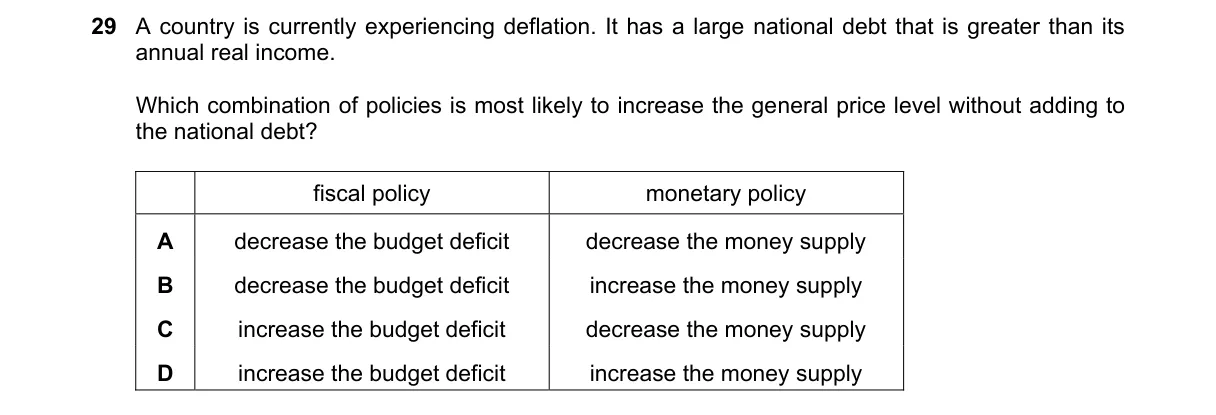
Answer choices
- Adecrease the budget deficit, decrease the money supply
- Bincrease the budget deficit, increase the money supply
- Cdecrease the budget deficit, increase the money supply
- Dincrease the budget deficit, decrease the money supply
Explanation
Expansionary Policies to Combat Deflation Steps:
- Deflation lowers prices; high debt-to-income ratio worsens real debt burden, requiring inflation to erode it.
- Increasing budget deficit raises aggregate demand via government spending or tax cuts.
- Increasing money supply lowers interest rates, encouraging investment and consumption to boost demand.
- Combined expansion maximizes price level rise through multiplicative effects on output and inflation.
Why B is correct:
- Quantity theory of money (MV = PY) shows increasing money supply (M) raises prices (P) if velocity (V) and output (Y) are stable; paired with deficit spending, it strongly shifts AD rightward without net debt addition via monetization.
Why the others are wrong:
- A: Both contractionary policies reduce AD, worsening deflation.
- C: Decreasing deficit contracts fiscal AD, offsetting monetary expansion's price effects.
- D: Deficit increases AD but shrinking money supply raises rates, contracting monetary AD and limiting price rise.
Final answer: B
Topic: Effectiveness of policy options to meet all macroeconomic objectives
Practice more A Level Economics (9708) questions on mMCQ.me