A Level Economics (9708)•9708/13/O/N/22
A Level Economics (9708) — 9708/13/O/N/22, Question 21
An economy is initially in equilibrium. Which combination of events will cause an increase in the general price level of the economy and a decrease in its real output?
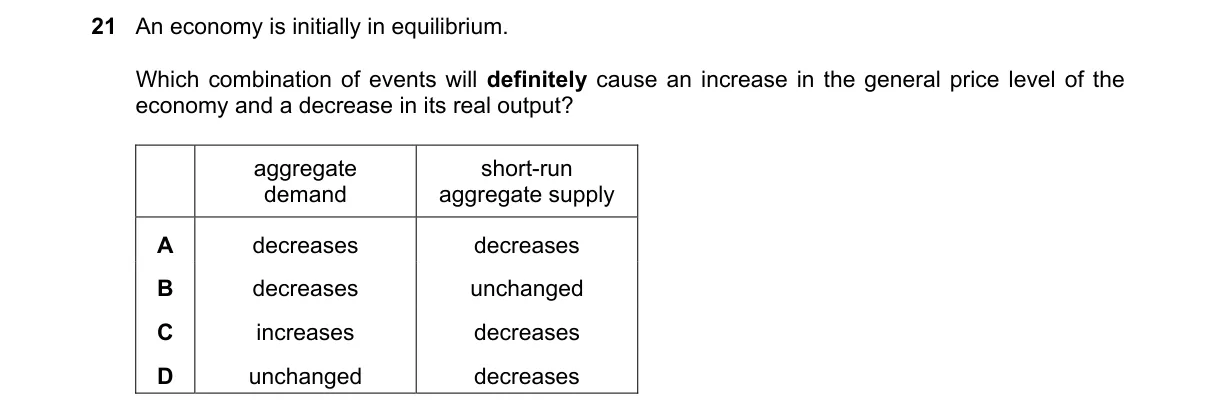
Answer choices
- Aaggregate demand decreases, short-run aggregate supply increases
- Baggregate demand increases, short-run aggregate supply unchanged
- Caggregate demand increases, short-run aggregate supply increases
- Daggregate demand unchanged, short-run aggregate supply decreases
Explanation
SRAS Shift Determines Stagflation Effect
Steps:
- Recall AD-AS model: Equilibrium at intersection of AD and SRAS curves, where price level (P) is vertical and real output (Y) horizontal.
- Identify desired outcome: Increase in P (upward movement) and decrease in Y (leftward movement) from initial equilibrium.
- Analyze shifts: Leftward SRAS shift raises P and lowers Y; rightward SRAS or AD shifts typically increase Y.
- Match options: Only unchanged AD with decreasing SRAS fits both conditions.
Why D is correct:
- A leftward SRAS shift (e.g., due to cost-push factors) intersects unchanged AD at higher P and lower Y, per the short-run aggregate supply curve definition.
Why the others are wrong:
- A: AD decrease lowers P and Y; SRAS increase lowers P and raises Y—net effect lowers P, not raises it.
- B: AD increase with unchanged SRAS raises both P and Y.
- C: Both increases raise Y; P may rise or stay same, but Y does not decrease.
Final answer: D
Topic: Aggregate Demand and Aggregate Supply analysis
Practice more A Level Economics (9708) questions on mMCQ.me