A Level Economics (9708)•9708/13/O/N/22
A Level Economics (9708) — 9708/13/O/N/22, Question 18
What does the incidence of an indirect tax on a product refer to?
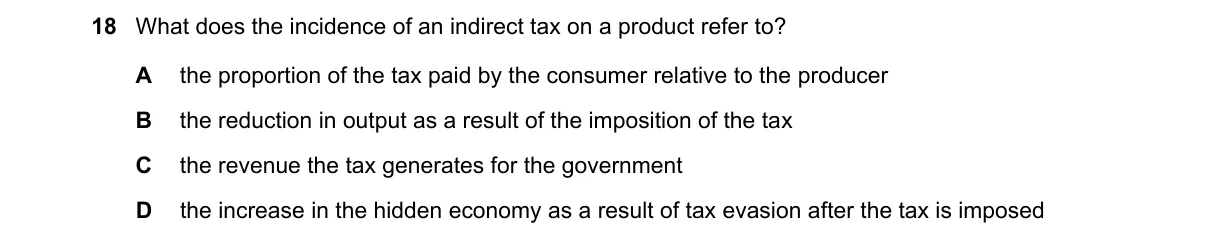
Answer choices
- Athe proportion of the tax paid by consumer relative to the producer
- Bthe reduction in output as a result of the imposition of the tax
- Cthe revenue the tax generates for the government
- Dthe increase in hidden economy as result of tax evasion after the tax is imposed
Explanation
Tax Incidence Defined
Steps:
- Recall that indirect taxes like sales tax shift costs between buyers and sellers based on elasticities.
- Define incidence as how the tax burden divides between consumer and producer prices.
- Evaluate options: A matches burden sharing; B describes deadweight loss; C is tax revenue; D is evasion effects.
- Select A as it directly aligns with economic incidence theory.
Why A is correct:
- Tax incidence refers to the division of the tax burden, where the proportion paid by consumers versus producers depends on supply and demand elasticities, as per standard microeconomic theory.
Why the others are wrong:
- B: This describes the deadweight loss from reduced quantity, not burden sharing.
- C: This measures government revenue, unrelated to who bears the tax.
- D: This refers to behavioral responses like evasion, not the core incidence concept.
Final answer: A
Topic: Methods and effects of government intervention in markets
Practice more A Level Economics (9708) questions on mMCQ.me