A Level Economics (9708)•9708/12/O/N/22
A Level Economics (9708) — 9708/12/O/N/22, Question 6
An indirect tax is imposed on a product, causing total expenditure by consumers to increase. Which row identifies this situation?
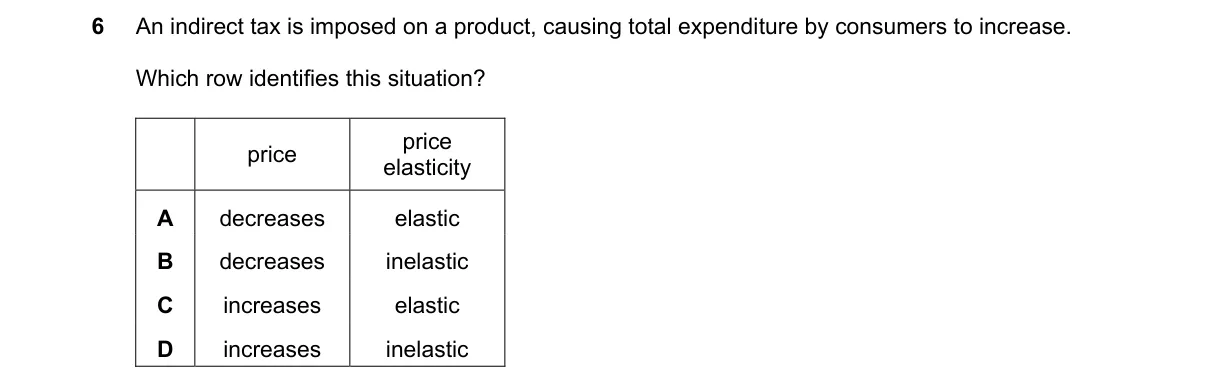
Answer choices
- Adecreases elastic
- Bdecreases elastic
- Cincreases elastic
- Dincreases inelastic
Explanation
Indirect Tax and Inelastic Demand
Steps:
- An indirect tax shifts the supply curve left, increasing price and decreasing quantity demanded.
- Total consumer expenditure is price times quantity.
- If expenditure rises after the tax, the price increase outweighs the quantity decrease.
- This occurs only when price elasticity of demand is less than 1 (inelastic).
Why D is correct:
- Inelastic demand means quantity falls less than price rises, so total expenditure increases per the elasticity formula |PED| < 1.
Why the others are wrong:
- A: Elastic demand causes expenditure to decrease as quantity falls more than price rises.
- B: Inelastic demand causes expenditure to increase, not decrease.
- C: Elastic demand causes expenditure to decrease despite price increase.
Final answer: D
Topic: Price elasticity, income elasticity and cross elasticity of demand
Practice more A Level Economics (9708) questions on mMCQ.me