A Level Economics (9708)•9708/11/O/N/22
A Level Economics (9708) — 9708/11/O/N/22, Question 30
Which combination of changes is most likely to result in a fall in a country's inflation rate?
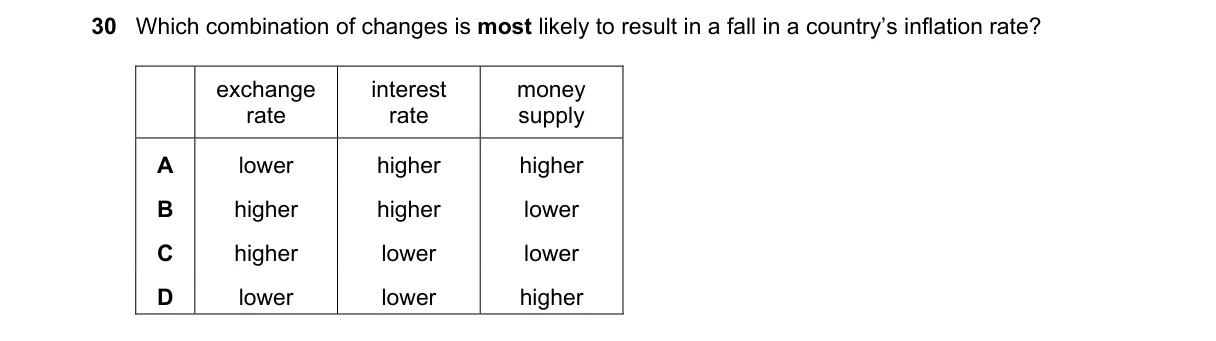
Answer choices
- AExchange rate: lower; Interest rate: higher; Money supply: higher
- BExchange rate: higher; Interest rate: higher; Money supply: lower
- CExchange rate: higher; Interest rate: lower; Money supply: lower
- DExchange rate: lower; Interest rate: lower; Money supply: higher
Explanation
Tightening Monetary Policy to Curb Inflation
Steps:
- Higher interest rates increase borrowing costs, reducing consumer and investment spending to lower demand-pull inflation.
- Lower money supply decreases available funds for spending, easing inflationary pressures via quantity theory of money (MV = PQ).
- Higher exchange rate appreciates the currency, making imports cheaper and reducing cost-push inflation from higher input prices.
- Combined, these reduce aggregate demand and costs, leading to lower overall inflation.
Why B is correct:
- Aligns with contractionary monetary policy, where higher rates and lower money supply slow money velocity and demand (per MV = PQ), while exchange rate appreciation cuts import costs.
Why the others are wrong:
- A: Lower exchange rate raises import prices (cost-push inflation); higher money supply fuels demand-pull inflation, outweighing higher rates.
- C: Lower interest rates boost spending and demand-pull inflation, countering benefits of higher exchange rate and lower money supply.
- D: Lower exchange rate and higher money supply both increase costs and demand, while lower rates amplify spending for higher inflation.
Final answer: B
Topic: Monetary policy
Practice more A Level Economics (9708) questions on mMCQ.me