A Level Economics (9708)•9708/11/O/N/22
A Level Economics (9708) — 9708/11/O/N/22, Question 12
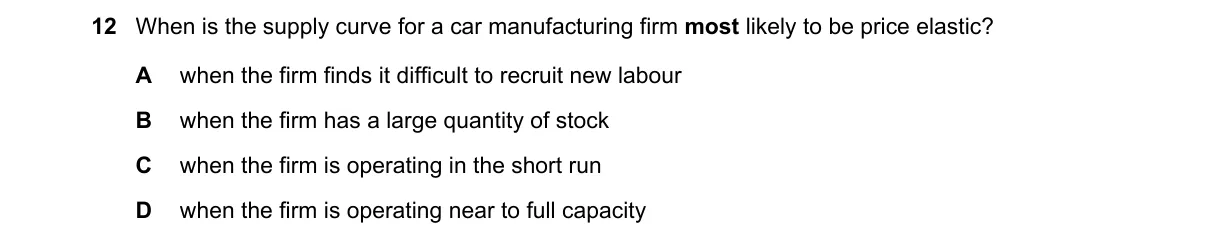
When is the supply curve for a car manufacturing firm most likely to be price elastic?
Answer choices
- Awhen the firm finds it difficult to recruit new labour
- Bwhen the firm has a large quantity of stock
- Cwhen the firm is operating in the short run
- Dwhen the firm is operating near full capacity
Explanation
Supply Elasticity Increases with Spare Resources
Steps:
- Define price elasticity of supply (PES) as the responsiveness of quantity supplied to price changes; PES >1 indicates elasticity.
- Identify key factors: PES is higher with spare capacity or inventory, allowing quick output increases without proportional cost rises.
- Evaluate options: Elastic supply occurs when firms can ramp up supply easily, like using existing stock.
- Select B, as it directly enables elastic response via pre-produced goods.
Why B is correct:
- Large stock provides spare capacity, allowing the firm to increase supply proportionally to price rises without production constraints (per the law of supply, where excess inventory boosts responsiveness).
Why the others are wrong:
- A: Labor recruitment issues limit production expansion, making supply inelastic due to input shortages.
- C: Short run fixes factors like capital, restricting output adjustments and causing inelasticity.
- D: Near full capacity means output can't increase much, leading to inelastic supply from production limits.
Final answer: B
Topic: Price elasticity of supply
Practice more A Level Economics (9708) questions on mMCQ.me