A Level Economics (9708)•9708/13/O/N/21
A Level Economics (9708) — 9708/13/O/N/21, Question 14
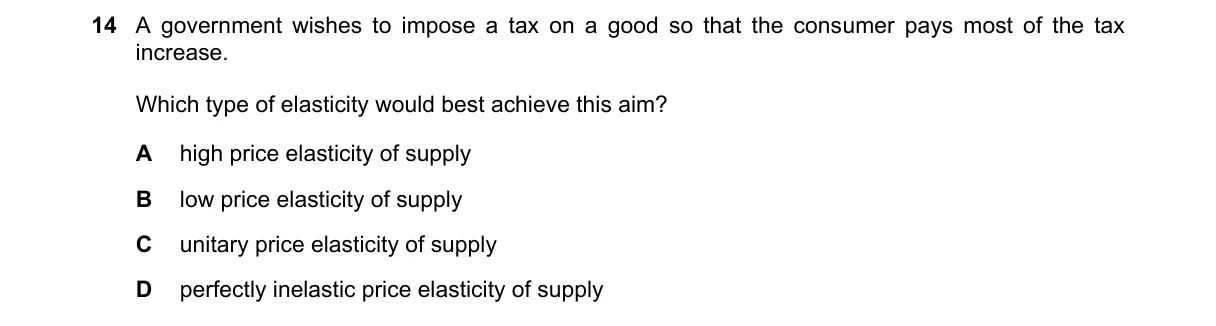
The government wishes to impose a tax on a good so that the consumer pays most of the tax. Which type of elasticity would best achieve this aim?
Answer choices
- Ahigh price elasticity of supply
- Blow price elasticity of supply
- Cunitary price elasticity of supply
- Dperfectly elastic price elasticity of supply
Explanation
Tax Incidence and Supply Elasticity
Steps:
- Tax incidence determines how the tax burden is split between consumers and producers based on elasticities.
- Consumers bear more of the tax when supply is elastic relative to demand, as producers can shift the burden by reducing output.
- High supply elasticity allows prices to rise significantly after tax, increasing consumer costs.
- Thus, to maximize consumer burden, choose high price elasticity of supply.
Why A is correct:
- With high supply elasticity, producers easily adjust quantity supplied upward in response to price changes, passing most of the tax to consumers via higher prices (per the tax incidence theorem).
Why the others are wrong:
- B: Low supply elasticity means producers absorb more tax, as they cannot easily adjust output, shifting burden to them.
- C: Unitary supply elasticity leads to shared burden, not predominantly on consumers.
- D: Perfectly elastic supply implies infinite responsiveness, but high elasticity (A) broadly achieves the aim without assuming extreme conditions.
Final answer: A
Topic: Price elasticity of supply
Practice more A Level Economics (9708) questions on mMCQ.me