A Level Economics (9708)•9708/13/O/N/21
A Level Economics (9708) — 9708/13/O/N/21, Question 13
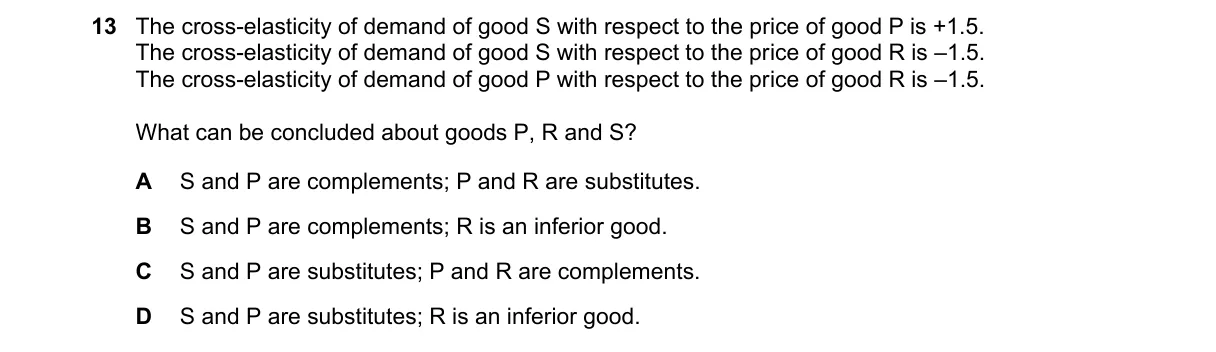
The cross-elasticity of demand of good S with respect to the price of good P is +1.5. The cross-elasticity of demand of good P with respect to the price of good R is -1.5. What can be concluded about goods P and R?
Answer choices
- AS and P are complements; P and R are substitutes.
- BS and P are complements; P and R are inferior goods.
- CS and P are substitutes; P and R are complements.
- DS and P are substitutes; P and R are inferior goods.
Explanation
Interpreting Cross-Price Elasticity Signs
Steps:
- Cross-price elasticity measures how demand for one good changes with another's price; positive value indicates substitutes, negative indicates complements.
- For S and P: +1.5 > 0, so demand for S rises when P's price rises, meaning S and P are substitutes.
- For P and R: -1.5 < 0, so demand for P falls when R's price rises, meaning P and R are complements.
- Inferior goods relate to income elasticity, not cross-price, so irrelevant here.
Why C is correct:
- C matches definitions: positive elasticity for S-P (substitutes) and negative for P-R (complements).
Why the others are wrong:
- A: Misclassifies S-P as complements (positive sign means substitutes).
- B: Misclassifies S-P as complements; inferior goods unrelated to cross-elasticity.
- D: Correctly identifies S-P substitutes but wrongly labels P-R inferior (negative sign means complements).
Final answer: C
Topic: Price elasticity, income elasticity and cross elasticity of demand
Practice more A Level Economics (9708) questions on mMCQ.me