A Level Economics (9708)•9708/13/O/N/21
A Level Economics (9708) — 9708/13/O/N/21, Question 12
The table shows the market demand and market supply for kiwifruit over a year. At a market price of $1 per kg total demand 220 thousand tonnes total supply 120 thousand tonnes. At $3 per kg total demand 160 thousand tonnes total supply 140 thousand tonnes. At $5 per kg total demand 100 thousand tonnes total supply 150 thousand tonnes. Which action would the government have to take to achieve market equilibrium at a price of $3 per kg?
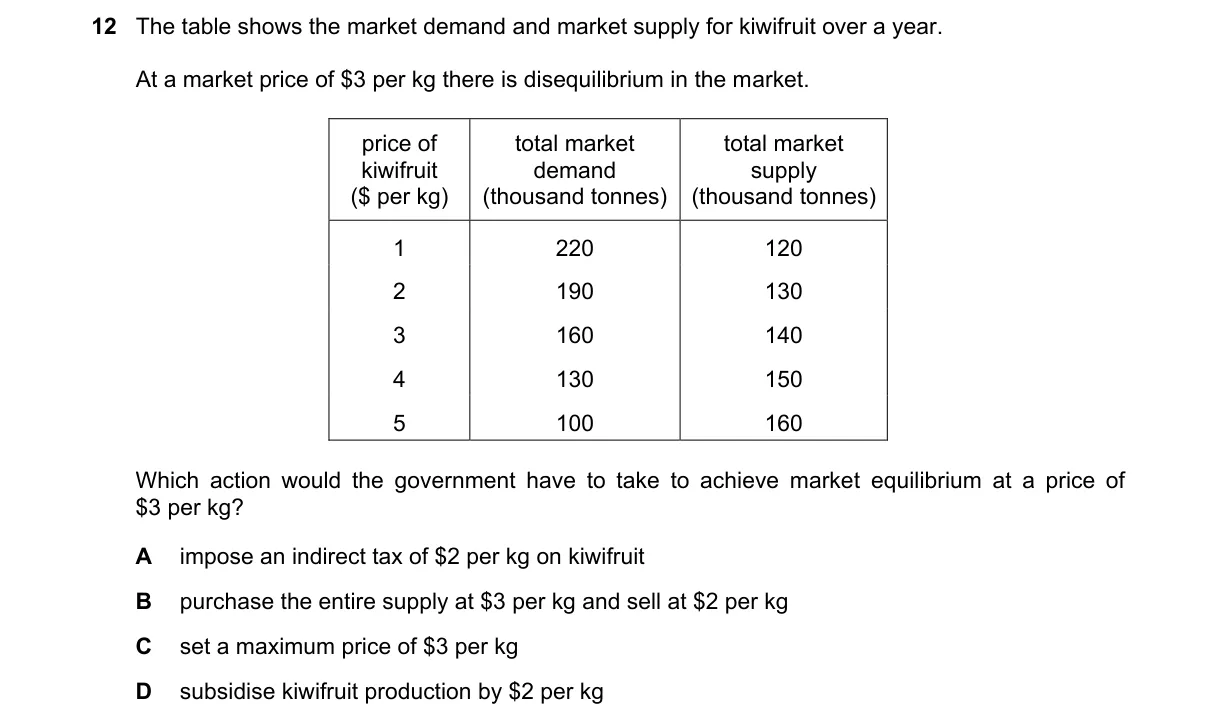
Answer choices
- AImpose an indirect tax of $2 per kg on kiwifruit
- Bpurchase the entire supply of $3 per kg and sell $2 per kg
- Csubsidise kiwifruit production by $2 per kg
- Dpurchase the entire supply at $3 per kg
Explanation
Government purchases supply to stabilize price at 3/kg, demand (160k tonnes) exceeds supply (140k tonnes), creating a 20k-tonne shortage; natural equilibrium price is higher. - Identify need for intervention to force balance at 3 ensures producers sell all output at that price, equilibrating supply side via government as buyer. Why D is correct: - By acting as the buyer for all supply at 2/kg shifts supply curve left, reducing supply further and raising equilibrium price above 3 and selling at 2/kg subsidy shifts supply right to …
Topic: Methods and effects of government intervention in markets
Practice more A Level Economics (9708) questions on mMCQ.me