A Level Economics (9708)•9708/12/O/N/21
A Level Economics (9708) — 9708/12/O/N/21, Question 8
What is an example of the rationing function of the price mechanism?
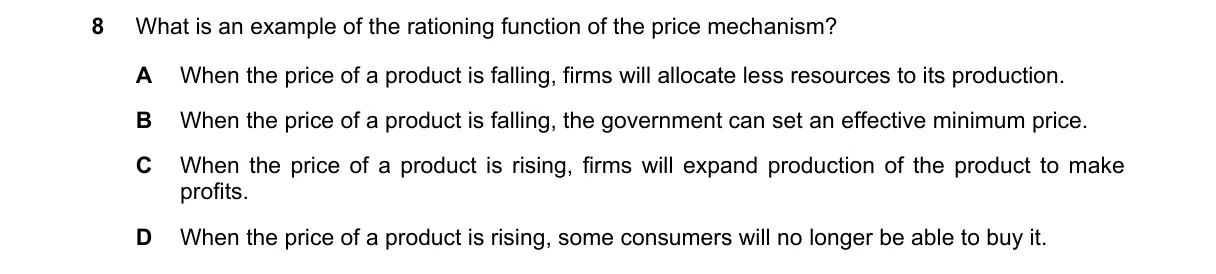
Answer choices
- AWhen the price of a product is falling, firms will allocate less resources to its production.
- BWhen the price of a product is falling, the government can set effective minimum price.
- CWhen the price of a product is rising, firms will expand production of the product to make profits.
- DWhen the price of a product is rising, some consumers will no longer be able to buy it.
Explanation
Price Rationing Limits Access to Scarce Goods
Steps:
- Define rationing function: Prices rise with scarcity, excluding lower-willingness buyers to allocate to highest bidders.
- Evaluate options against definition: Check if they show prices restricting consumer access without intervention.
- Eliminate mismatches: Discard production-focused or government-involved choices.
- Confirm match: Select option illustrating consumer exclusion via higher prices.
Why D is correct:
- Rationing occurs when rising prices due to scarcity make goods unaffordable, allocating them to consumers with highest willingness to pay, per basic supply-demand law.
Why the others are wrong:
- A: Describes resource reallocation in production (incentive function), not consumer rationing.
- B: Involves government price controls, bypassing market price mechanism.
- C: Shows producer response to price signals for expansion, not limiting consumer access.
Final answer: D
Topic: The interaction of demand and supply
Practice more A Level Economics (9708) questions on mMCQ.me