A Level Economics (9708)•9708/12/O/N/21
A Level Economics (9708) — 9708/12/O/N/21, Question 25
The table shows the number of biscuits and cakes that can be produced by four workers in an hour. Who has the greatest comparative advantage in producing biscuits?
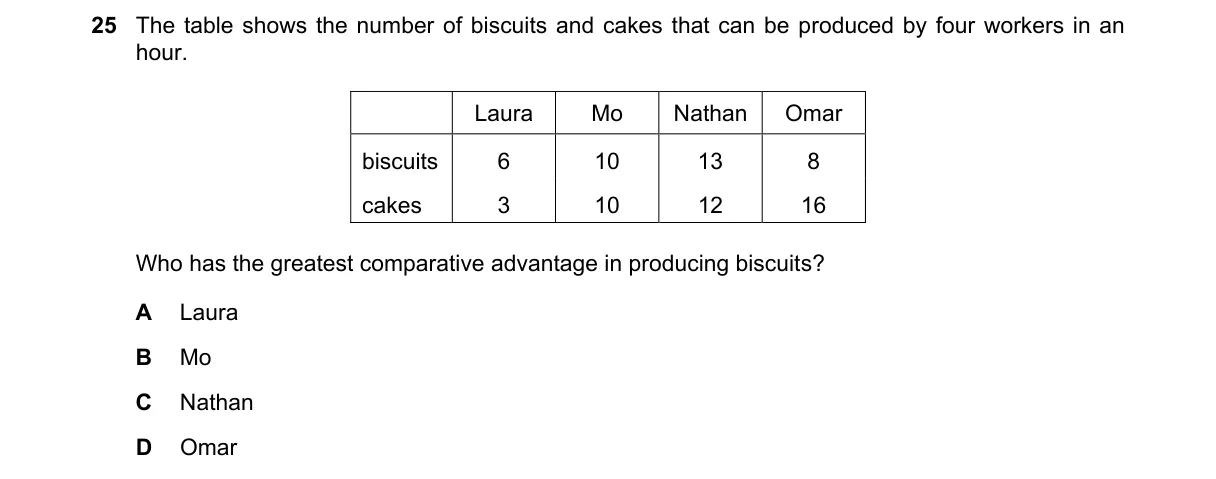
Answer choices
- ALaura
- BMo
- CNathan
- DOmar
Explanation
Comparative advantage from lowest opportunity cost of biscuits Steps:
- Compute opportunity cost of 1 biscuit for each worker: cakes forgone = max cakes / max biscuits per hour.
- Laura: 5/10 = 0.5 cakes per biscuit.
- Mo: 6/8 = 0.75; Nathan: 4/6 ≈ 0.67; Omar: 3/4 = 0.75.
- Lowest cost identifies greatest comparative advantage in biscuits.
Why A is correct:
- Laura's opportunity cost (0.5 cakes per biscuit) is lowest, defining comparative advantage as lowest forgone alternative.
Why the others are wrong:
- B. Mo: Opportunity cost (0.75) exceeds Laura's.
- C. Nathan: Opportunity cost (0.67) exceeds Laura's.
- D. Omar: Opportunity cost (0.75) exceeds Laura's.
Final answer: A
Topic: Scarcity, choice and opportunity cost
Practice more A Level Economics (9708) questions on mMCQ.me