A Level Economics (9708)•9708/12/O/N/21
A Level Economics (9708) — 9708/12/O/N/21, Question 19
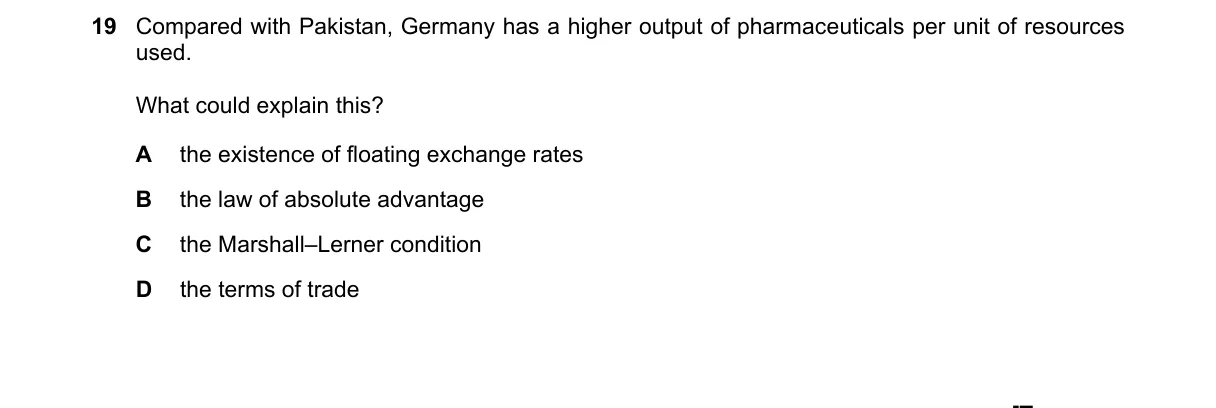
Compared with Pakistan, Germany has a higher output of pharmaceuticals per unit of resources used. What could explain this?
Answer choices
- Athe existence of floating exchange rates
- Bthe law of absolute advantage
- Cthe Marshall-Lerner condition
- Dthe terms of trade
Explanation
Absolute Advantage Explains Higher Productivity
Steps:
- Identify the scenario: Germany produces more pharmaceuticals per resource unit than Pakistan, indicating superior efficiency.
- Recall absolute advantage: A country has it if it produces more output with the same resources compared to another.
- Apply to question: Germany's higher output per resources fits absolute advantage in pharmaceuticals.
- Rule out unrelated concepts: Exchange rates, trade conditions, and terms don't directly explain production efficiency.
Why B is correct:
- The law of absolute advantage states a country benefits from specializing in goods it produces more efficiently (higher output per input) than others, directly explaining Germany's edge.
Why the others are wrong:
- A: Floating exchange rates affect currency values and trade flows, not production efficiency.
- C: The Marshall-Lerner condition determines if devaluation improves trade balance, unrelated to output per resources.
- D: Terms of trade involve export/import price ratios, not domestic production productivity.
Final answer: B
Topic: The reasons for international trade
Practice more A Level Economics (9708) questions on mMCQ.me