A Level Economics (9708)•9708/11/O/N/21
A Level Economics (9708) — 9708/11/O/N/21, Question 7
What can be measured by cross-elasticity of demand?
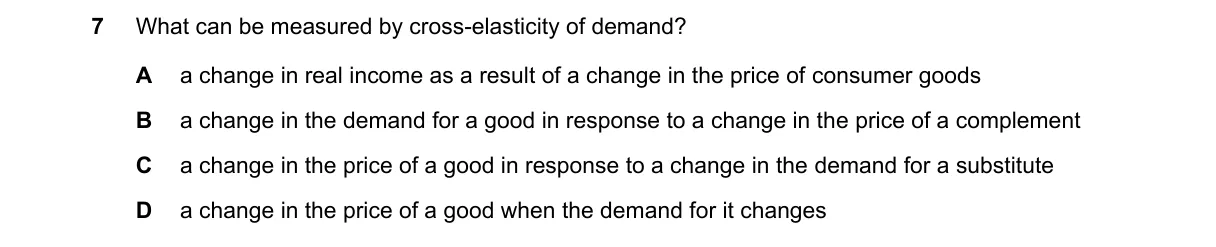
Answer choices
- Aa change in real income as a result of a change in the price of a complement
- Ba change in the demand for a good in response to a change in the price of a complement
- Ca change in the price of a good in response to a change in the demand for a substitute
- Da change in the price of a good when the demand for it changes
Explanation
Cross-elasticity measures demand responsiveness to another good's price change
Steps:
- Recall cross-elasticity of demand (XED) formula: % change in quantity demanded of good X / % change in price of good Y.
- Identify it applies to related goods like substitutes (positive XED) or complements (negative XED).
- Evaluate choices: A mentions income, which relates to income elasticity; B fits XED directly for complements.
- Eliminate unrelated options: C and D focus on price changes, not demand responsiveness.
Why B is correct:
- Cross-elasticity of demand is defined as the percentage change in demand for one good divided by the percentage change in price of another good, directly measuring response to a complement's price change.
Why the others are wrong:
- A: Measures income effects, not cross-price effects; that's income elasticity.
- C: Describes supply-side price adjustments, not demand elasticity.
- D: Refers to general price-demand shifts, akin to own-price elasticity, not cross-effects.
Final answer: B
Topic: Price elasticity, income elasticity and cross elasticity of demand
Practice more A Level Economics (9708) questions on mMCQ.me