A Level Economics (9708)•9708/11/O/N/21
A Level Economics (9708) — 9708/11/O/N/21, Question 23
Country X and country Y both produce rice and tables. Half of their resources are used to produce rice and the other half to produce tables. The resulting output of each product is given in the table shown. Country Rice Tables X 150 50 Y 100 50 What can be concluded from the table?
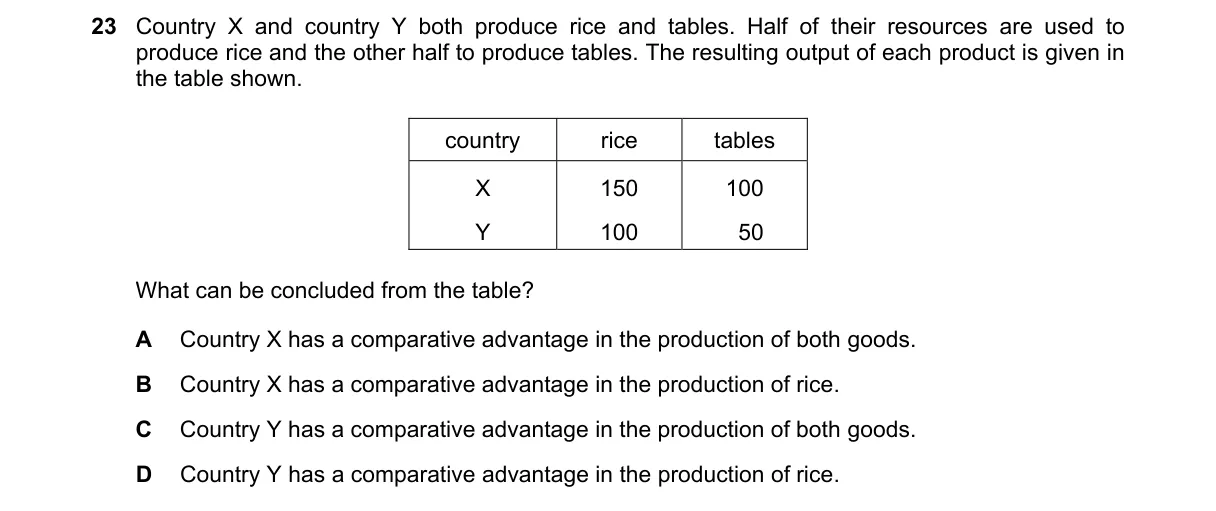
Answer choices
- ACountry X has a comparative advantage in the production of rice.
- BCountry Y has a comparative advantage in the production of rice.
- CCountry X has a comparative advantage in the production of tables.
- DCountry Y has a comparative advantage in the production of tables.
Explanation
Comparative advantage via opportunity costs
Steps:
- Calculate opportunity cost of rice for X: 50 tables / 150 rice = 1/3 table per rice.
- Calculate opportunity cost of rice for Y: 50 tables / 100 rice = 1/2 table per rice.
- X has lower opportunity cost for rice (1/3 < 1/2), so comparative advantage in rice.
- Calculate opportunity cost of tables for Y: 100 rice / 50 tables = 2 rice per table (lower than X's 3 rice per table), so Y has comparative advantage in tables.
Why D is correct:
- Y's opportunity cost of producing tables (2 rice) is lower than X's (3 rice), per the definition of comparative advantage as lower relative opportunity cost.
Why the others are wrong:
- A: X has lower opportunity cost for rice, not Y.
- B: Y's opportunity cost for rice (1/2 table) is higher than X's (1/3 table).
- C: X's opportunity cost for tables (3 rice) is higher than Y's (2 rice).
Final answer: D
Topic: The reasons for international trade
Practice more A Level Economics (9708) questions on mMCQ.me