A Level Economics (9708)•9708/11/O/N/21
A Level Economics (9708) — 9708/11/O/N/21, Question 15
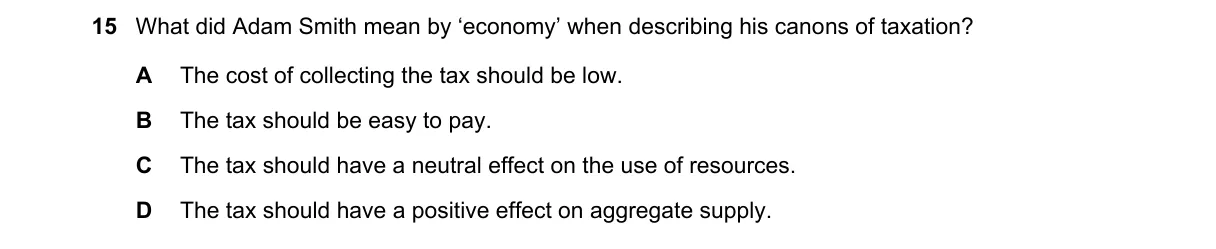
What did Adam Smith mean by 'economy' when describing his canons of taxation?
Answer choices
- AThe cost of collecting the tax should be low.
- BThe tax should be easy to pay.
- CThe tax should have a neutral effect on the use of resources.
- DThe tax should have a positive effect on aggregate supply.
Explanation
Adam Smith's Canon of Economy in Taxation
Steps:
- Recall Adam Smith's four canons of taxation: equity, certainty, convenience, and economy.
- Focus on the canon of economy, which addresses efficient tax administration.
- Define economy as minimizing collection costs relative to revenue raised.
- Match this definition to the provided choices.
Why A is correct:
- Smith's canon of economy explicitly requires that the cost of collecting taxes be kept as low as possible to maximize net revenue, per his definition in "The Wealth of Nations."
Why the others are wrong:
- B: Refers to the canon of convenience, emphasizing ease of payment for taxpayers.
- C: Describes modern tax neutrality or efficiency, not addressed in Smith's canons.
- D: Relates to macroeconomic effects, absent from Smith's 18th-century principles.
Final answer: A
Topic: Methods and effects of government intervention in markets
Practice more A Level Economics (9708) questions on mMCQ.me