A Level Economics (9708)•9708/13/O/N/20
A Level Economics (9708) — 9708/13/O/N/20, Question 29
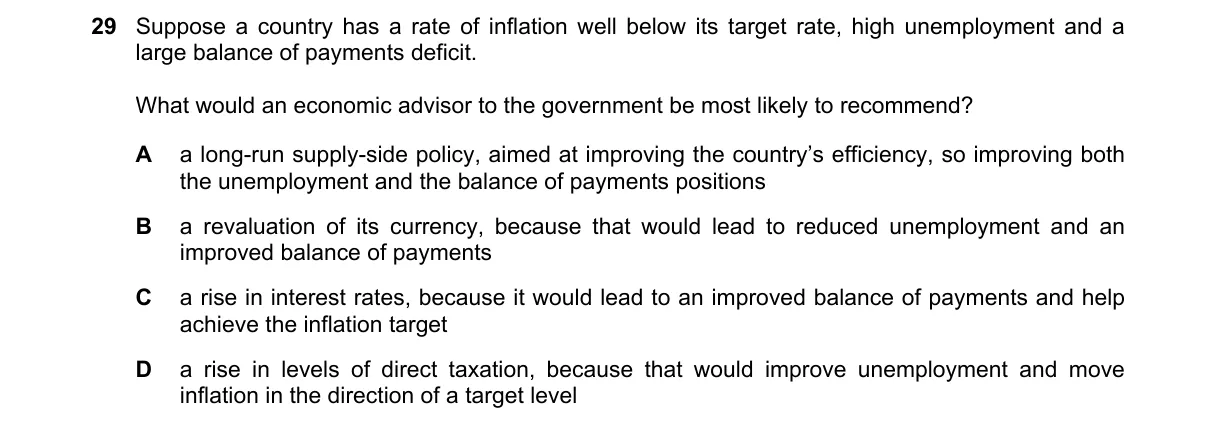
Suppose a country has a rate of inflation well below its target, high unemployment and a balance of payments deficit. What would an economic advisor to the government be most likely to recommend?
Answer choices
- Aa long-run supply-side policy aimed at improving the country's efficiency, so improving both the unemployment and balance of payments positions
- Ba revaluation of its currency, because that would lead to reduced unemployment and an improvement in the balance of payments
- Ca rise in levels of direct taxation, because that would lead to an improvement in the balance of payments and help achieve the inflation target
- Dinflation in the direction of target level that would improve unemployment and move balance of payments in the direction of target level
Explanation
Supply-side policies target structural economic issues
Steps:
- Assess problems: low inflation allows expansion, but high unemployment signals structural inefficiencies; BOP deficit indicates poor competitiveness.
- Match to long-run solutions: supply-side policies boost productivity and efficiency to address root causes.
- Evaluate impacts: improved efficiency reduces unemployment via better job creation and fixes BOP by enhancing export competitiveness.
- Confirm recommendation: advisor prioritizes sustainable, multi-issue fixes over short-term demand tweaks.
Why A is correct:
- Supply-side policies increase potential output (Y = f(L, K, Tech)), reducing natural unemployment rate and improving net exports via lower costs/higher productivity.
Why the others are wrong:
- B: Revaluation appreciates currency, raising export prices and worsening BOP deficit while risking higher unemployment from reduced AD.
- C: Higher direct taxes contract AD (C + I + G + (X-M) falls), exacerbating unemployment and low inflation without directly aiding BOP.
- D: Targeting higher inflation via demand stimulus boosts short-run output but ignores structural BOP issues and risks overheating without efficiency gains.
Final answer: A
Topic: Effectiveness of policy options to meet all macroeconomic objectives
Practice more A Level Economics (9708) questions on mMCQ.me