A Level Economics (9708)•9708/13/O/N/20
A Level Economics (9708) — 9708/13/O/N/20, Question 24
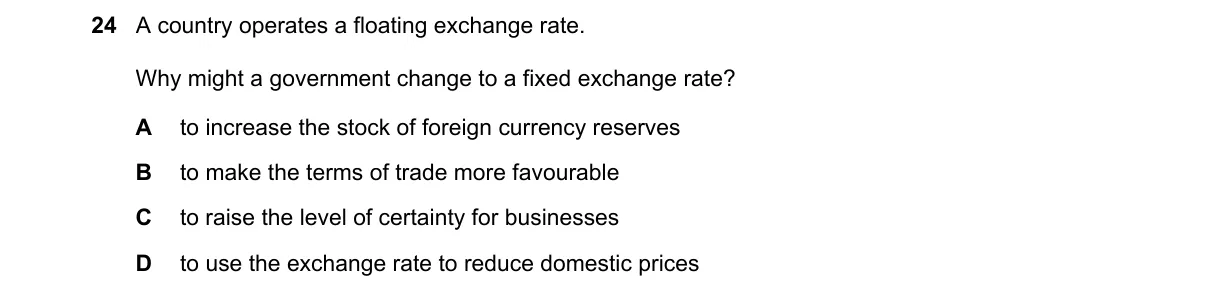
A country operates a floating exchange rate. Why might a government change to fixed exchange rate?
Answer choices
- Ato increase the stock of foreign currency reserves
- Bto make the terms of trade more favourable
- Cto raise level of certainty for businesses
- Dto use the exchange rate to reduce domestic prices
Explanation
Fixed rates provide exchange rate stability
Steps:
- Identify the key difference: Floating rates fluctuate with market forces, creating uncertainty; fixed rates are pegged to a stable value.
- Consider government goals: Governments switch to fixed rates to eliminate volatility in currency values.
- Evaluate business impacts: Businesses prefer predictable exchange rates for planning imports, exports, and investments.
- Match to options: Certainty for businesses aligns with the stability benefit of fixed rates.
Why C is correct:
- Fixed exchange rates anchor the currency to a stable value, reducing volatility and providing predictability essential for business planning, as per international trade theory.
Why the others are wrong:
- A: Fixed rates often deplete reserves to defend the peg, not increase them.
- B: Terms of trade depend on export/import price ratios, unaffected directly by the exchange rate regime.
- D: Fixed rates stabilize but do not inherently reduce domestic prices, which depend on monetary policy.
Final answer: C
Topic: Exchange rates
Practice more A Level Economics (9708) questions on mMCQ.me