A Level Economics (9708)•9708/13/O/N/20
A Level Economics (9708) — 9708/13/O/N/20, Question 20
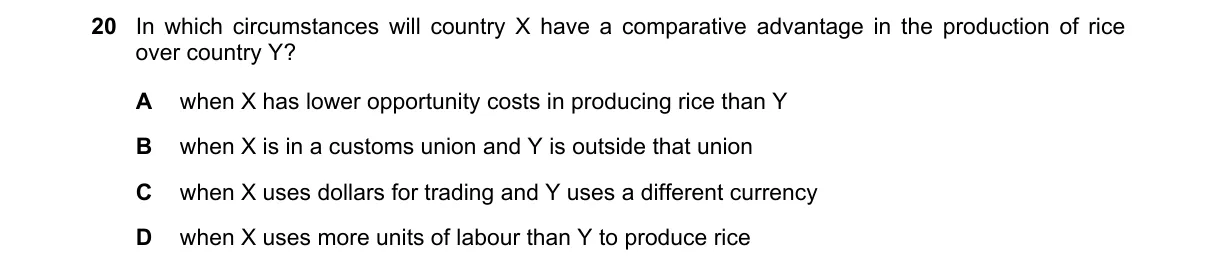
In which circumstances will country X have a comparative advantage in the production of rice over country Y?
Answer choices
- Awhen X has lower opportunity costs in producing rice than Y
- Bwhen X is in a customs union and Y is outside that union
- Cwhen X uses dollars for trade and Y uses a different currency
- Dwhen X uses more units of labour than Y to produce rice
Explanation
Comparative Advantage via Opportunity Costs
Steps:
- Define comparative advantage as the ability to produce a good at a lower opportunity cost than another country.
- Identify opportunity cost as the value of the next-best alternative forgone when producing rice.
- Evaluate choices: A matches the definition directly; others involve unrelated factors like trade agreements or inputs.
- Confirm A aligns with Ricardo's theory of comparative advantage.
Why A is correct:
- Comparative advantage exists when a country has a lower opportunity cost in producing a good, per David Ricardo's principle, enabling mutual gains from trade.
Why the others are wrong:
- B: Customs unions affect trade barriers, not production efficiency or costs.
- C: Currency differences impact transactions, not inherent production advantages.
- D: Absolute labor units measure absolute advantage, not comparative (which focuses on relative costs).
Final answer: A
Topic: The reasons for international trade
Practice more A Level Economics (9708) questions on mMCQ.me