A Level Economics (9708)•9708/12/O/N/20
A Level Economics (9708) — 9708/12/O/N/20, Question 29
A government reduces its expenditure on workplace training, increases the level of indirect taxes, and reduces the rate of interest it pays on government debt. How would these government macroeconomic policies be categorised?
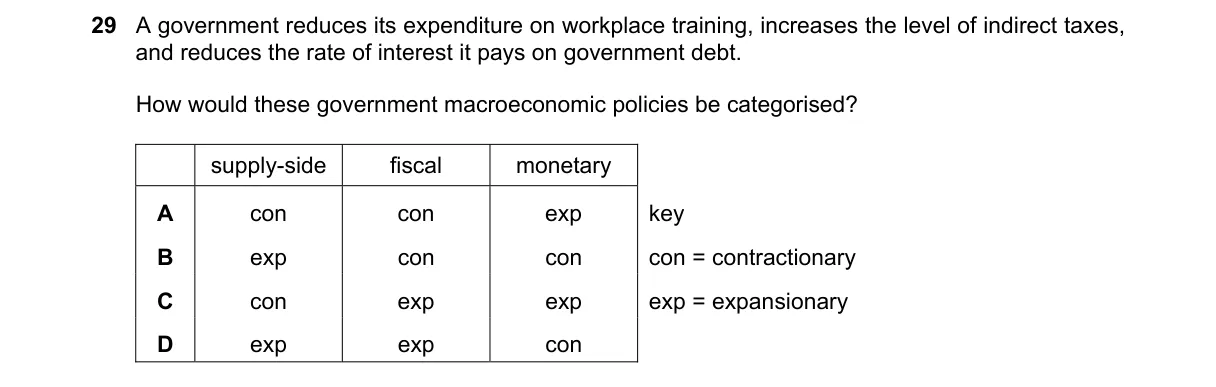
Answer choices
- Asupply-side con, fiscal con, monetary exp, key = contractionary
- Bsupply-side exp, fiscal con, monetary con, con = contractionary
- Csupply-side exp, fiscal exp, monetary con, exp = expansionary
- Dsupply-side exp, fiscal exp, monetary con, exp = expansionary
Explanation
Classifying macroeconomic policies by type and expansionary/contractionary effects
Steps:
- Reducing workplace training expenditure cuts human capital investment, a contractionary supply-side policy.
- Decreasing government spending and raising indirect taxes both reduce aggregate demand, making fiscal policy contractionary.
- Lowering interest paid on government debt eases monetary conditions by reducing borrowing costs, an expansionary monetary policy.
- Overall effect is contractionary, as fiscal and supply-side contractions outweigh monetary expansion.
Why A is correct:
- It accurately categorizes each policy's type and direction per standard definitions: supply-side affects long-run capacity (contractionary here), fiscal changes G and T (both contractionary), monetary adjusts interest rates (expansionary), with net contractionary impact.
Why the others are wrong:
- B: Misclassifies supply-side as expansionary (training cut reduces supply) and monetary as contractionary (rate cut expands).
- C: Misclassifies supply-side and fiscal as expansionary (both are contractionary) and overall as expansionary.
- D: Identical errors to C in policy directions and overall effect.
Final answer: A
Topic: Government macroeconomic policy objectives
Practice more A Level Economics (9708) questions on mMCQ.me