A Level Economics (9708)•9708/12/O/N/20
A Level Economics (9708) — 9708/12/O/N/20, Question 28
A government uses monetary policy and fiscal policy to solve a problem of deflation. Which policy combination is likely to be most successful?
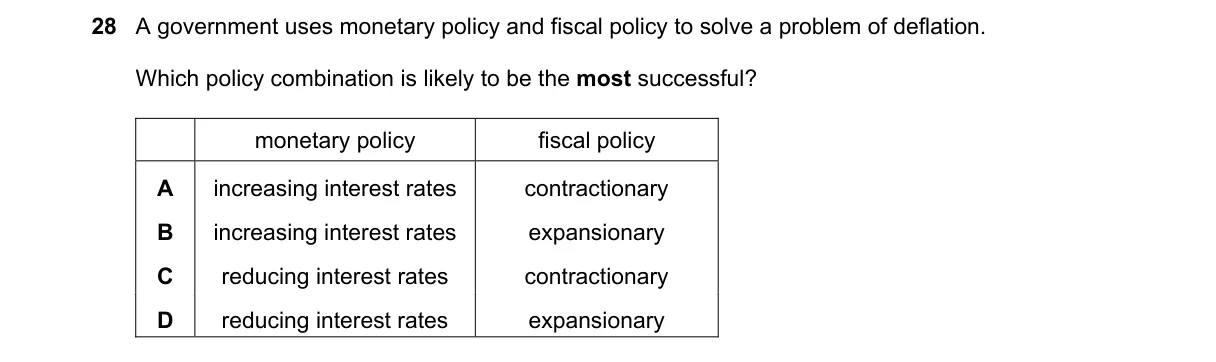
Answer choices
- AIncreasing interest rates (monetary policy), contractionary (fiscal policy)
- BIncreasing interest rates (monetary policy), expansionary (fiscal policy)
- CReducing interest rates (monetary policy), contractionary (fiscal policy)
- DReducing interest rates (monetary policy), expansionary (fiscal policy)
Explanation
Expansionary Policies to Boost Aggregate Demand Against Deflation
Steps:
- Deflation involves falling prices and reduced aggregate demand, requiring policies to stimulate spending and investment.
- Expansionary monetary policy reduces interest rates, lowering borrowing costs to encourage consumption and business expansion.
- Expansionary fiscal policy increases government spending or cuts taxes, directly injecting money into the economy.
- Combining both policies maximizes demand stimulation for effective deflation reversal.
Why D is correct:
- Both policies expand aggregate demand (AD = C + I + G + NX), countering deflation per Keynesian stabilization theory.
Why the others are wrong:
- A: Both contractionary policies reduce AD, exacerbating deflation.
- B: Higher interest rates curb investment, offsetting fiscal stimulus and weakening overall impact.
- C: Reduced government spending or higher taxes dampen demand, countering monetary easing.
Final answer: D
Topic: Effectiveness of policy options to meet all macroeconomic objectives
Practice more A Level Economics (9708) questions on mMCQ.me