A Level Economics (9708)•9708/12/O/N/20
A Level Economics (9708) — 9708/12/O/N/20, Question 25
The diagram shows aggregate demand curves AD1, AD2, and aggregate supply curve AS1. What could cause the shift in aggregate demand from AD1 to AD2?
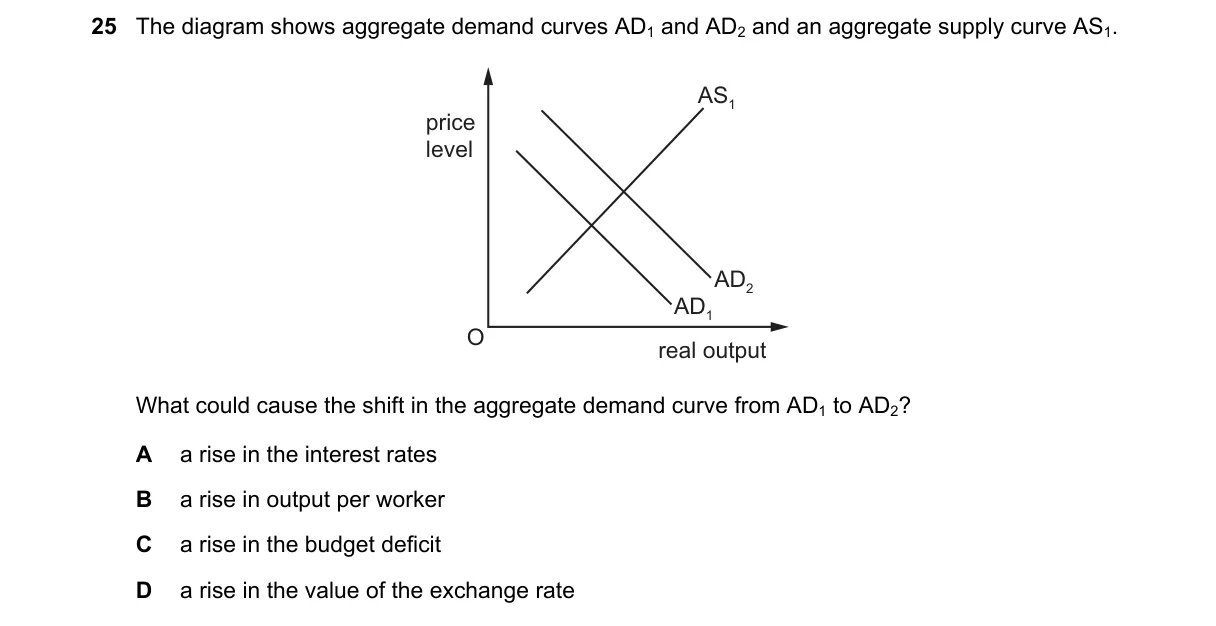
Answer choices
- Aa rise in the interest rates
- Ba rise in output per worker
- Ca rise in the budget deficit
- Da rise in the value of the exchange rate
Explanation
Shifts in Aggregate Demand Curve
Steps:
- Identify the direction of the shift: Assume AD2 is to the right of AD1, indicating an increase in aggregate demand.
- Recall AD components: AD = C + I + G + (X - M); shifts occur from changes in these excluding price level.
- Evaluate each option: Check if it increases C, I, G, or net exports.
- Select the option that boosts overall spending without affecting supply side.
Why C is correct:
- A rise in the budget deficit means higher government spending or lower taxes, directly increasing G or C, shifting AD right per the AD equation.
Why the others are wrong:
- A: Higher interest rates reduce I and C, shifting AD left.
- B: Higher output per worker boosts productivity, shifting AS right, not AD.
- D: Higher exchange rate (appreciation) reduces X and increases M, shifting AD left.
Final answer: C
Topic: Aggregate Demand and Aggregate Supply analysis
Practice more A Level Economics (9708) questions on mMCQ.me