A Level Economics (9708)•9708/12/O/N/20
A Level Economics (9708) — 9708/12/O/N/20, Question 24
A country has a balance of payments deficit. It devalues its currency. Which combination leads to a reduction in its balance of payments deficit in the long run?
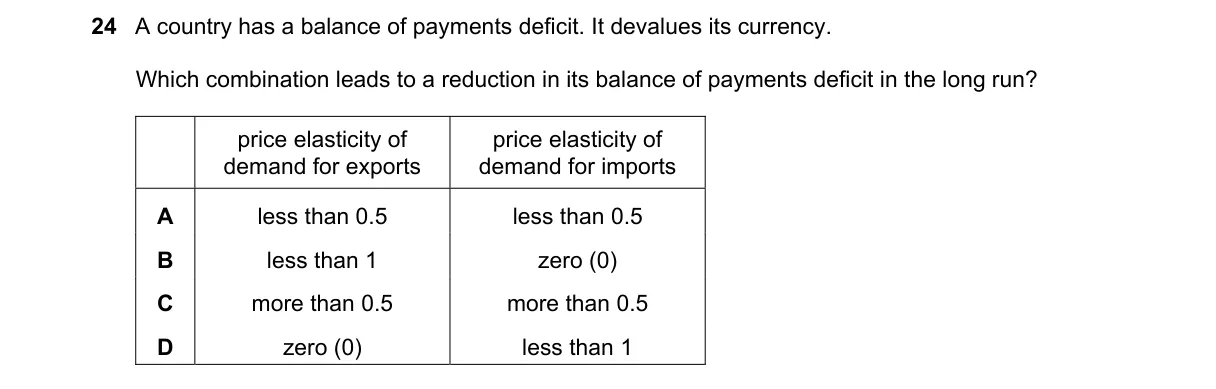
Answer choices
- Aprice elasticity of demand for exports less than 1, price elasticity of demand for imports less than 0.5
- Bprice elasticity of demand for exports less than 0.5, price elasticity of demand for imports zero (0)
- Cprice elasticity of demand for exports more than 0.5, price elasticity of demand for imports more than 1
- Dprice elasticity of demand for exports zero (0), price elasticity of demand for imports less than 1
Explanation
Marshall-Lerner Condition for Trade Balance Improvement
Steps:
- Devaluation lowers export prices and raises import prices in foreign currency.
- Volume of exports rises if demand elasticity for exports exceeds 0; import volume falls if elasticity for imports exceeds 0.
- Trade balance improves if percentage increase in export value exceeds percentage decrease in import value.
- This requires sum of absolute price elasticities of demand for exports and imports >1 (Marshall-Lerner condition), effective in long run as elasticities rise.
Why C is correct:
- Elasticities >0.5 and >1 sum to >1.5, satisfying Marshall-Lerner condition for net export gain post-devaluation.
Why the others are wrong:
- A: Sum <1.5 but elasticities too low to guarantee >1, so deficit may not reduce.
- B: Sum <0.5 <1, violating condition; imports unresponsive.
- D: Sum <1, violating condition; exports unresponsive.
Final answer: C
Topic: Policies to correct imbalances in the current account of the balance of payments
Practice more A Level Economics (9708) questions on mMCQ.me