A Level Economics (9708)•9708/12/O/N/20
A Level Economics (9708) — 9708/12/O/N/20, Question 20
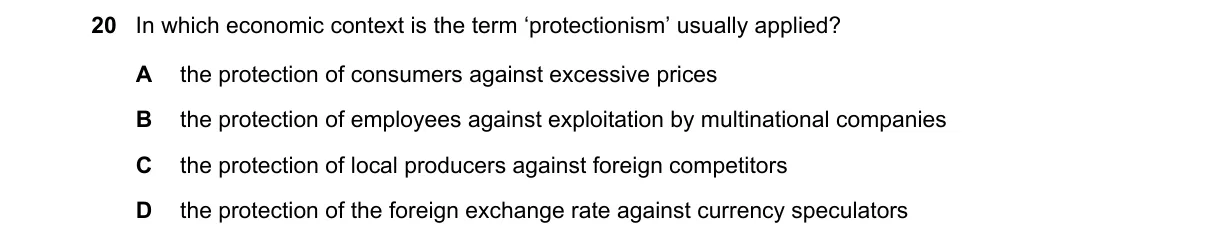
In which economic context is the term 'protectionism' usually applied?
Answer choices
- Athe protection of consumers against excessive prices
- Bthe protection of employees against exploitation by multinational companies
- Cthe protection of local producers against foreign competitors
- Dthe protection of the foreign exchange rate against currency speculators
Explanation
Protectionism Shields Domestic Industries from Foreign Competition
Steps:
- Recall that protectionism involves government policies restricting imports to support local economies.
- Examine each option to match the core definition of protecting domestic producers.
- Eliminate choices focused on consumers, workers, or currency, as they describe unrelated protections.
- Confirm the option aligning with trade barriers like tariffs or quotas.
Why C is correct:
- Protectionism is defined in economics as policies (e.g., tariffs, quotas) that shield local producers from cheaper foreign competitors, preserving domestic jobs and industries.
Why the others are wrong:
- A: Consumer protection addresses price gouging via antitrust laws, not trade policies.
- B: Labor protections involve regulations like minimum wage, unrelated to import restrictions.
- D: Exchange rate defense uses monetary tools like interventions, not protectionist trade measures.
Final answer: C
Topic: Protectionism
Practice more A Level Economics (9708) questions on mMCQ.me