A Level Economics (9708)•9708/12/O/N/20
A Level Economics (9708) — 9708/12/O/N/20, Question 19
Under which combination of circumstances will a policy increasing the money supply be most effective moving an economy out of recession?
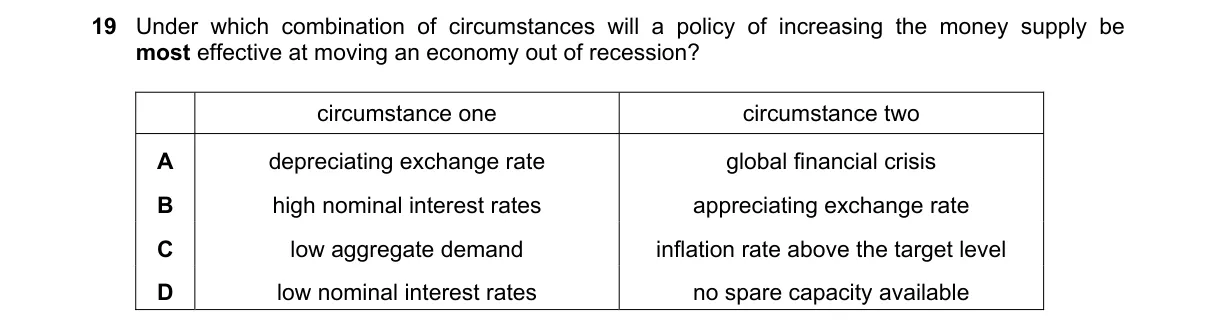
Answer choices
- Adepreciating exchange rate, global financial crisis
- Bhigh nominal interest rates, appreciating exchange rate
- Clow aggregate demand, inflation rate above target level
- Dlow nominal interest rates, no spare capacity available
Explanation
Monetary Policy Transmission in Recession
Steps:
- Expansionary monetary policy increases money supply, lowering interest rates to boost investment and depreciating the currency to enhance exports.
- Effectiveness requires room to cut rates (high current nominal rates) and a beneficial depreciation (current appreciating exchange rate).
- In recession, low demand and spare capacity amplify policy impact without inflationary pressures.
- Eliminate options where barriers like low rates, full capacity, or external shocks hinder transmission.
Why B is correct:
- High nominal rates allow significant cuts per the interest rate channel; appreciating exchange rate enables depreciation to stimulate net exports via the exchange rate channel.
Why the others are wrong:
- A: Global financial crisis impairs credit transmission, reducing policy effectiveness despite depreciation.
- C: Inflation above target signals overheating, not recession, limiting expansionary policy scope.
- D: Low nominal rates hit zero lower bound (liquidity trap); no spare capacity risks inflation without output gains.
Final answer: B
Topic: Effectiveness of policy options to meet all macroeconomic objectives
Practice more A Level Economics (9708) questions on mMCQ.me