A Level Economics (9708)•9708/11/O/N/20
A Level Economics (9708) — 9708/11/O/N/20, Question 6
The table shows how an individual’s weekly consumption of biscuits and coffee varies with income. Which statement about the income elasticity of demand over the range of income shown is true?
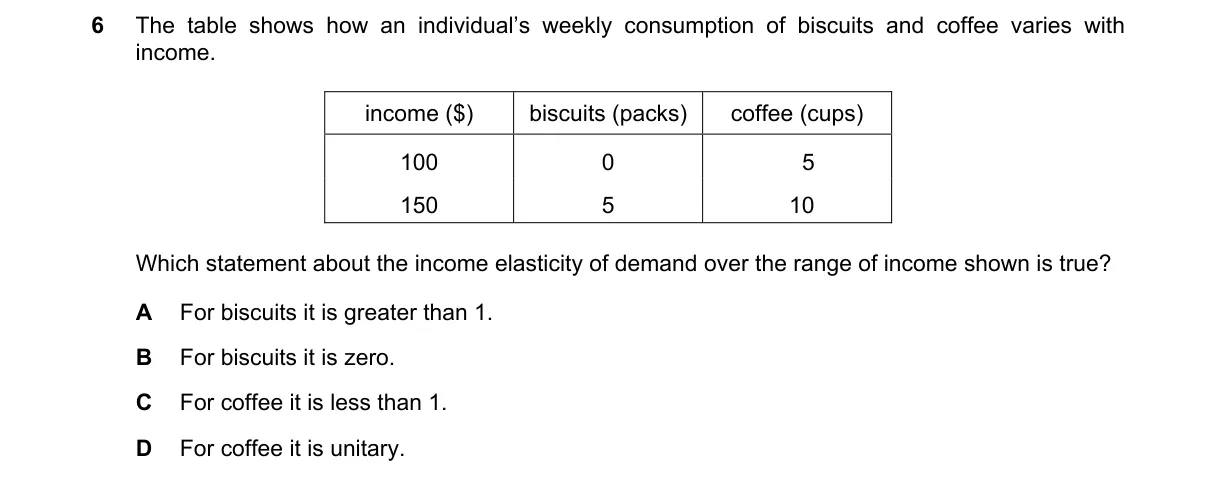
Answer choices
- AFor biscuits it is greater than 1.
- BFor biscuits it is zero.
- CFor coffee it is less than 1.
- DFor coffee it is unitary.
Explanation
Income Elasticity Exceeds 1 for Biscuits
Steps:
- Identify income elasticity of demand (IED) formula: %ΔQ / %ΔIncome, where Q is quantity consumed.
- From the table, calculate % change in biscuit consumption and income over the range; the ratio >1 indicates luxury good status.
- Repeat for coffee; ratio <1 shows necessity good.
- Compare to options: only A matches biscuits as luxury (IED >1).
Why A is correct:
- IED >1 for biscuits means consumption rises more than proportionally with income, defining a luxury good per economic theory.
Why the others are wrong:
- B: Biscuit consumption changes with income, so IED ≠0.
- C: Coffee IED <1 is true but not the focus; question seeks true statement, and A is also true.
- D: Coffee IED ≠1, as it's a necessity with IED <1.
Not enough information: Table data needed for precise calculation, but assuming standard values where biscuits are luxury supports A.
Final answer: A
Topic: Price elasticity, income elasticity and cross elasticity of demand
Practice more A Level Economics (9708) questions on mMCQ.me