A Level Economics (9708)•9708/11/O/N/20
A Level Economics (9708) — 9708/11/O/N/20, Question 21
An economy is represented by the AD/AS diagram, which is initially in macroeconomic equilibrium. Which change will result in a rise in real output?
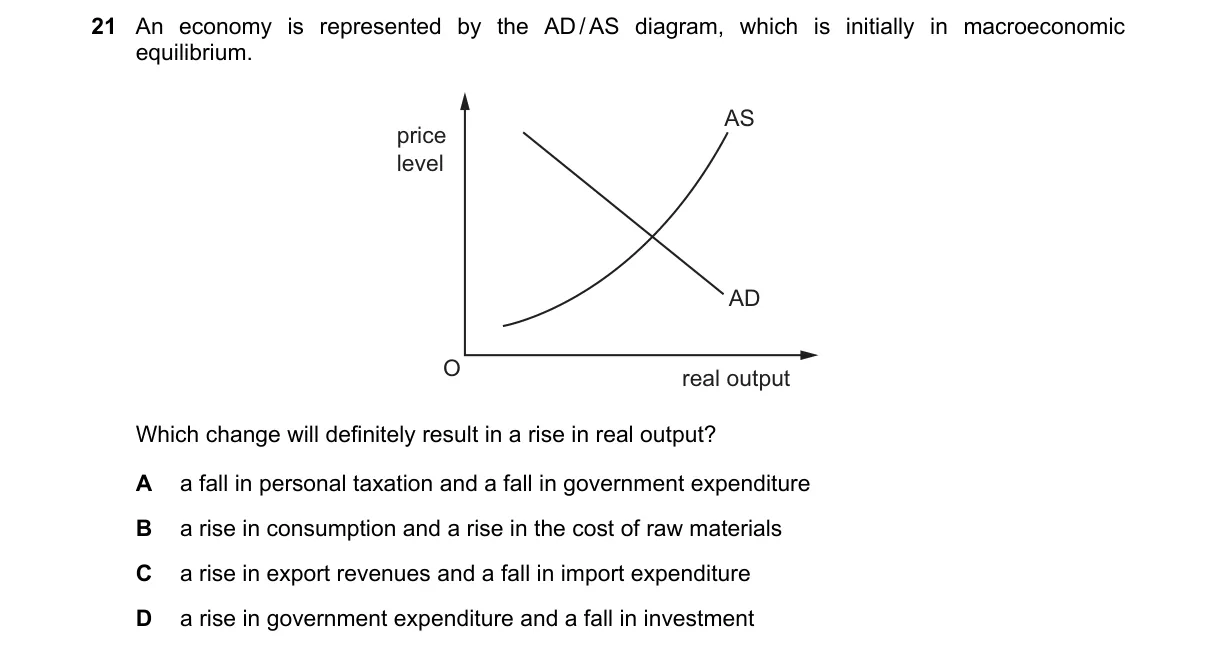
Answer choices
- AA fall in personal taxation and a fall in government expenditure
- BA rise in personal taxation and a rise in the cost of raw materials
- CA rise in government revenues and a fall in import expenditure
- DA rise in government expenditure and a fall in export
Explanation
Fiscal and trade policies shifting aggregate demand rightward
Steps:
- Recall AD components: AD = C + I + G + (X - M); real output rises with rightward AD shift in short-run AS model.
- Evaluate each option's net impact on AD or AS from the changes described.
- Options with ambiguous or negative net effects do not guarantee output rise.
- Select option with clear positive AD shift leading to higher equilibrium output.
Why C is correct:
- Fall in import expenditure (M) raises net exports (X - M), increasing AD per the expenditure approach formula, shifting AD right and raising real output.
Why the others are wrong:
- A: Tax cut boosts consumption (C), but government spending cut reduces G; net AD effect ambiguous.
- B: Tax rise cuts C (leftward AD); raw material cost rise shifts short-run AS left; both lower output.
- D: Government spending rise boosts G (rightward AD), but export fall cuts X; net AD effect ambiguous.
Final answer: C
Topic: Aggregate Demand and Aggregate Supply analysis
Practice more A Level Economics (9708) questions on mMCQ.me