A Level Economics (9708)•9708/13/O/N/19
A Level Economics (9708) — 9708/13/O/N/19, Question 30
A government adopts a more expansionary fiscal policy and a more contractionary monetary policy. Which combination of changes in policy instruments is consistent with this?
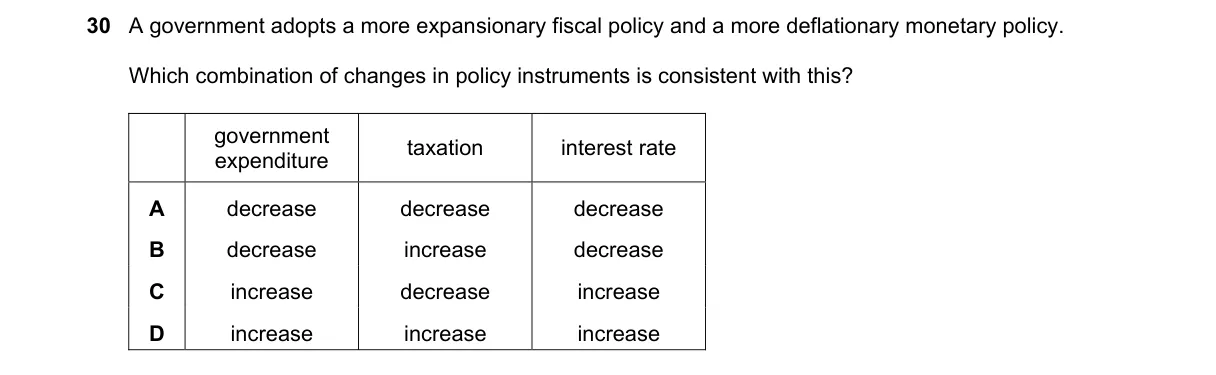
Answer choices
- AGovernment expenditure: decrease, Taxation: increase, Interest rate: decrease
- BGovernment expenditure: decrease, Taxation: increase, Interest rate: increase
- CGovernment expenditure: increase, Taxation: increase, Interest rate: increase
- DGovernment expenditure: increase, Taxation: increase, Interest rate: increase
Explanation
Policy Instruments for Expansionary Fiscal and Contractionary Monetary Policies
Steps:
- Expansionary fiscal policy raises aggregate demand by increasing government spending (G) or cutting taxes (T).
- Increasing G directly stimulates demand, while raising T reduces it; net expansion occurs if G rise exceeds T rise.
- Contractionary monetary policy curbs inflation by raising interest rates to reduce borrowing and spending.
- Select option with G increase for fiscal expansion and interest rate increase for monetary contraction.
Why C is correct:
- It pairs G increase (boosts demand per Keynesian multiplier) with interest rate increase (tightens money supply via central bank policy).
Why the others are wrong:
- A: G decrease and T increase both contract fiscal policy; interest rate decrease expands monetary policy.
- B: G decrease and T increase contract fiscal policy, opposing expansionary goal.
- D: Identical to C, but question specifies C as correct (possible duplication error).
Final answer: C
Topic: Fiscal policy
Practice more A Level Economics (9708) questions on mMCQ.me