A Level Economics (9708)•9708/13/O/N/19
A Level Economics (9708) — 9708/13/O/N/19, Question 27
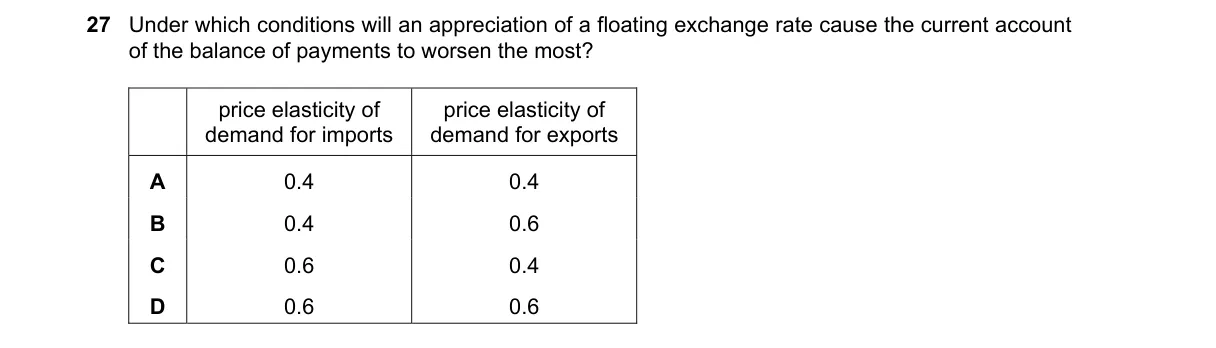
Under which conditions will appreciation of floating exchange rate cause the current account balance of payments to worsen most?
Answer choices
- Aprice elasticity of demand for imports: 0.4, price elasticity of demand for exports: 0.6
- BOption B
- Cprice elasticity of demand for imports: 0.6, price elasticity of demand for exports: 0.4
- Dprice elasticity of demand for imports: 0.6, price elasticity of demand for exports: 0.6
Explanation
Appreciation Worsens Current Account Most with High Trade Elasticities
Steps:
- Appreciation raises export prices abroad and lowers import prices domestically, reducing export volume and increasing import volume.
- The magnitude of volume changes depends on price elasticities: higher elasticity amplifies quantity responses.
- Current account worsens by net effect of export decline minus import rise; largest worsening occurs with highest elasticities.
- Compare sums: A (1.0), C (1.0), D (1.2); D yields biggest imbalance per Marshall-Lerner framework.
Why D is correct:
- Both elasticities at 0.6 (sum >1) maximize quantity shifts, causing largest trade deficit per Marshall-Lerner condition for currency appreciation.
Why the others are wrong:
- A: Lower import elasticity (0.4) limits import surge, reducing overall worsening.
- C: Lower export elasticity (0.4) dampens export drop, muting deficit growth.
- B: Not enough information (option incomplete).
Final answer: D
Topic: Exchange rates
Practice more A Level Economics (9708) questions on mMCQ.me