A Level Economics (9708)•9708/12/O/N/19
A Level Economics (9708) — 9708/12/O/N/19, Question 10
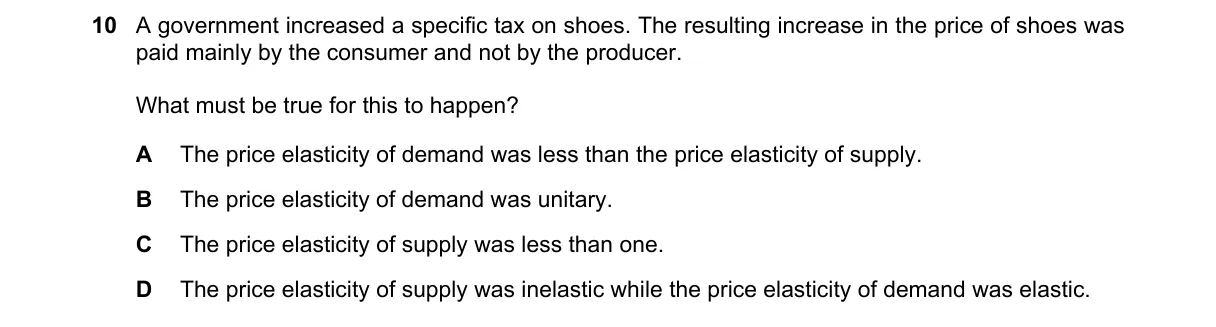
A government increased a tax on shoes. The resulting increase in the price of shoes was paid mainly by the consumer and not by the producer. What must be true for this to happen?
Answer choices
- AThe price elasticity of demand was less than the price elasticity of supply.
- BThe price elasticity of demand was unitary
- CThe price elasticity of supply was inelastic while the price elasticity of demand was elastic.
- DThe price elasticity of supply was inelastic while the price elasticity of demand was elastic.
Explanation
Tax Incidence Depends on Relative Elasticities
Steps:
- Taxes shift supply curve up by tax amount; new equilibrium price rises by portion of tax.
- Incidence on consumers is larger when demand curve is steeper (less elastic) relative to supply.
- If demand elasticity < supply elasticity, price increase ≈ tax amount, so consumers pay most.
- Elasticity comparison determines burden split.
Why A is correct:
- Tax incidence theorem: Burden falls more on side with lower price elasticity; if |Ed| < |Es|, consumers absorb most via higher prices.
Why the others are wrong:
- B: Unitary demand elasticity (|Ed| = 1) implies equal burden sharing, not mainly on consumers.
- C: Inelastic supply (|Es| < 1) and elastic demand (|Ed| > 1) mean producers bear most burden.
- D: Identical to C, so same error—reverses elasticities, shifting burden to producers.
Final answer: A
Topic: Methods and effects of government intervention in markets
Practice more A Level Economics (9708) questions on mMCQ.me