A Level Economics (9708)•9708/11/O/N/19
A Level Economics (9708) — 9708/11/O/N/19, Question 3
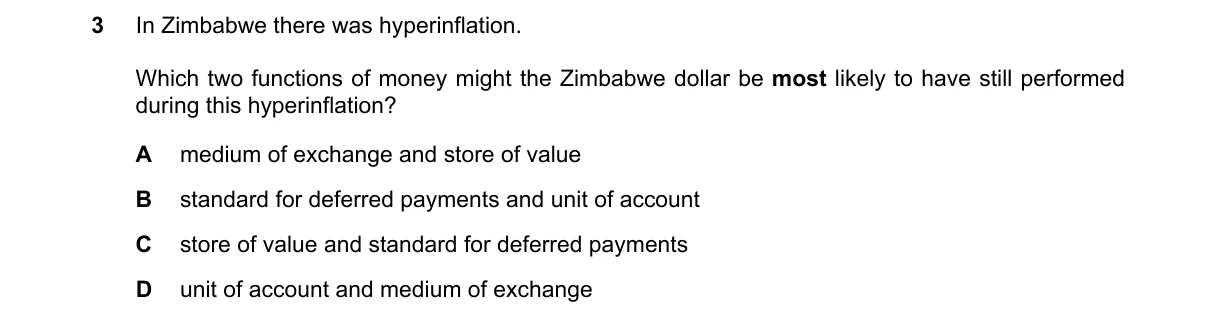
Which two functions of money might the Zimbabwe dollar be most likely to have performed during hyperinflation in Zimbabwe?
Answer choices
- Amedium of exchange and store of value
- Bstandard for deferred payments and unit of account
- Cstore of value and standard for deferred payments
- Dunit of account and medium of exchange
Explanation
Hyperinflation impairs value-holding functions of money
Steps:
- Identify money's four functions: medium of exchange, unit of account, store of value, standard of deferred payment.
- Recognize hyperinflation causes rapid value loss, undermining store of value and standard of deferred payment.
- Note that medium of exchange persists for transactions, as people still trade with local currency.
- Conclude unit of account holds, as prices are quoted in the currency despite high inflation.
Why D is correct:
- Unit of account and medium of exchange align with the definition of money's roles in pricing goods and facilitating trades, which continued in Zimbabwe as alternatives were limited.
Why the others are wrong:
- A: Store of value fails, as hyperinflation erodes purchasing power quickly.
- B: Standard for deferred payments fails due to unreliable future value for loans or contracts.
- C: Both store of value and standard for deferred payments collapse under extreme inflation.
Final answer: D
Topic: Money and banking
Practice more A Level Economics (9708) questions on mMCQ.me