A Level Economics (9708)•9708/11/O/N/19
A Level Economics (9708) — 9708/11/O/N/19, Question 28
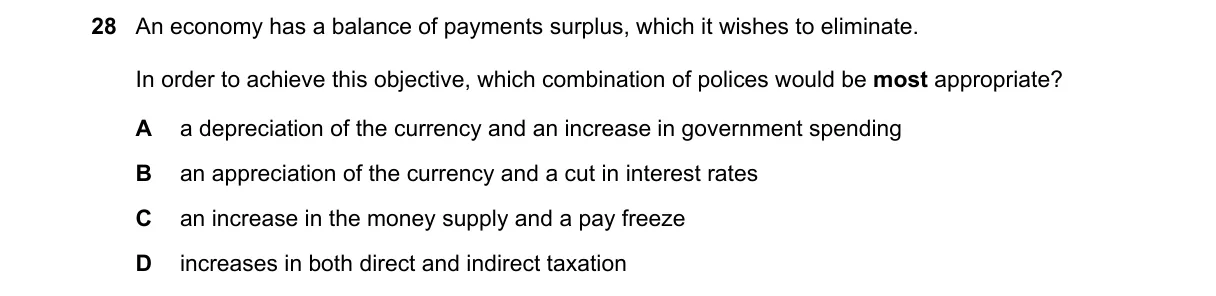
An economy has a balance of payments surplus, which it wishes to eliminate. In order to achieve this objective, which combination of policies would be most appropriate?
Answer choices
- Aa depreciation of the currency and an increase in government spending
- Ban appreciation of the currency and a cut in interest rates
- Can increase in money supply and a pay freeze
- Dincreases in both direct and indirect taxation
Explanation
Reducing Balance of Payments Surplus via Exchange Rate and Monetary Policy
Steps:
- Balance of payments surplus occurs when inflows exceed outflows in current and capital accounts.
- To eliminate surplus, policies must worsen the current account (reduce exports or increase imports) or reduce capital inflows.
- Currency appreciation makes exports costlier and imports cheaper, reducing net exports.
- Cutting interest rates lowers returns on investments, discouraging foreign capital inflows.
Why B is correct:
- Appreciation reduces export competitiveness per the Marshall-Lerner condition, worsening current account; lower interest rates reduce capital inflows via the interest rate parity theory.
Why the others are wrong:
- A: Depreciation boosts net exports, increasing surplus; higher government spending may raise imports but net effect likely worsens the goal.
- C: Money supply increase lowers rates to cut capital inflows but pay freeze controls wages without directly addressing BOP surplus.
- D: Tax increases reduce domestic spending and imports, improving current account and enlarging surplus.
Final answer: B
Topic: Policies to correct disequilibrium in the balance of payments
Practice more A Level Economics (9708) questions on mMCQ.me