A Level Economics (9708)•9708/11/O/N/19
A Level Economics (9708) — 9708/11/O/N/19, Question 21
The table shows the amount of good X and the amount of good Y that can be produced by country R and country T each uses all of its resources. What can be concluded from the table?
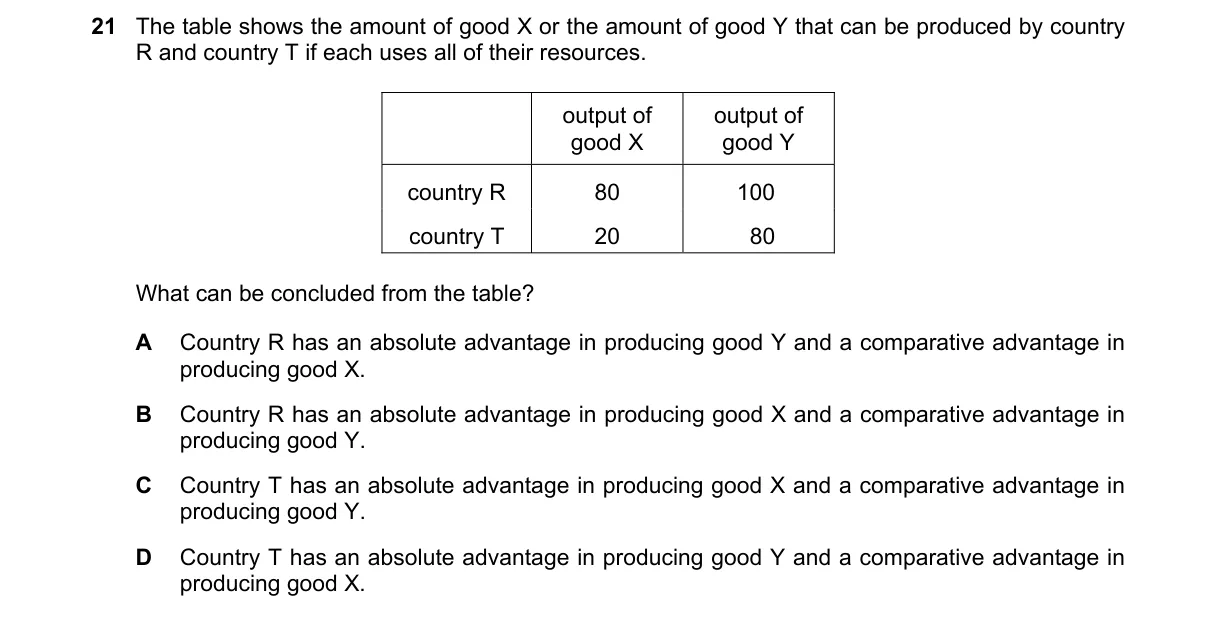
Answer choices
- ACountry R has an absolute advantage in producing good Y and a comparative advantage in
- BCountry R has an absolute advantage in producing good X and a comparative advantage in
- CCountry T has an absolute advantage in producing good X and a comparative advantage in
- DCountry T has an absolute advantage in producing good Y and a comparative advantage in producing good X.
Explanation
Absolute and Comparative Advantages in Production
Steps:
- Identify absolute advantage by comparing total output: country with higher production of a good using all resources has absolute advantage.
- Calculate opportunity cost for each good: units of one good forgone to produce one unit of the other.
- Determine comparative advantage: country with lower opportunity cost for a good has comparative advantage in it.
- Match findings to choices based on table data for goods X and Y.
Why A is correct:
- Country R produces more Y than T with all resources (absolute advantage definition), and R's opportunity cost of X (Y forgone per X) is lower than T's (comparative advantage via opportunity cost).
Why the others are wrong:
- B: R has absolute advantage in X, not Y, per table outputs.
- C: T lacks absolute advantage in X; R produces more X.
- D: T has no absolute advantage in Y; R produces more Y.
Final answer: A
Topic: The reasons for international trade
Practice more A Level Economics (9708) questions on mMCQ.me