A Level Economics (9708)•9708/11/O/N/19
A Level Economics (9708) — 9708/11/O/N/19, Question 16
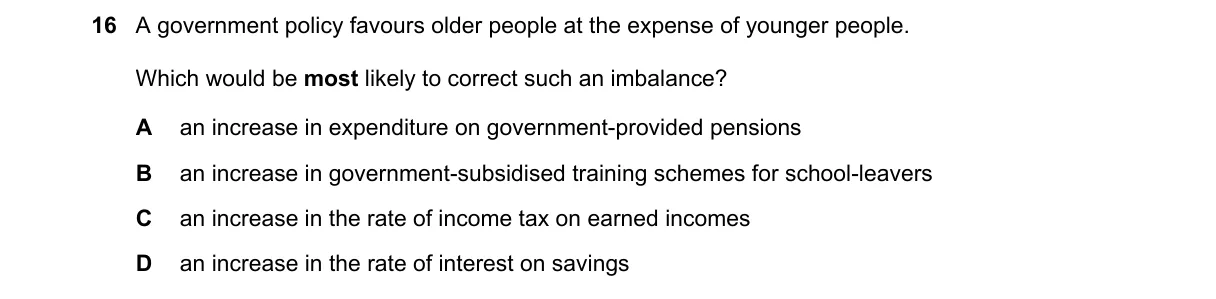
A government policy favours older people at the expense of younger people. Which would most likely correct such imbalance?
Answer choices
- Aan increase in expenditure on government-provided pensions
- Ban increase in government-subsidised training schemes for school-leavers
- Can increase in the rate of income tax on earned incomes
- Dan increase in the rate of interest on savings
Explanation
Addressing intergenerational inequity via youth support
Steps:
- Identify the imbalance: government policy benefits older people (e.g., pensions) over younger ones (e.g., limited opportunities).
- Evaluate options for actions that directly aid younger people without further favoring the elderly.
- Assess impact: seek policies enhancing youth employability and skills to balance resource allocation.
- Select the option promoting long-term equity through investment in the young workforce.
Why B is correct:
- Subsidized training for school-leavers builds human capital for youth, countering elder favoritism per economic theory of intergenerational equity, which emphasizes fair resource distribution across age groups.
Why the others are wrong:
- A: Boosts pensions, directly benefiting older people and worsening the imbalance.
- C: Raises taxes on workers' incomes, burdening young earners without targeted youth relief.
- D: Higher savings interest aids retirees with accumulated wealth, favoring older savers.
Final answer: B
Topic: Equity and redistribution of income and wealth
Practice more A Level Economics (9708) questions on mMCQ.me