A Level Economics (9708)•9708/11/O/N/19
A Level Economics (9708) — 9708/11/O/N/19, Question 12
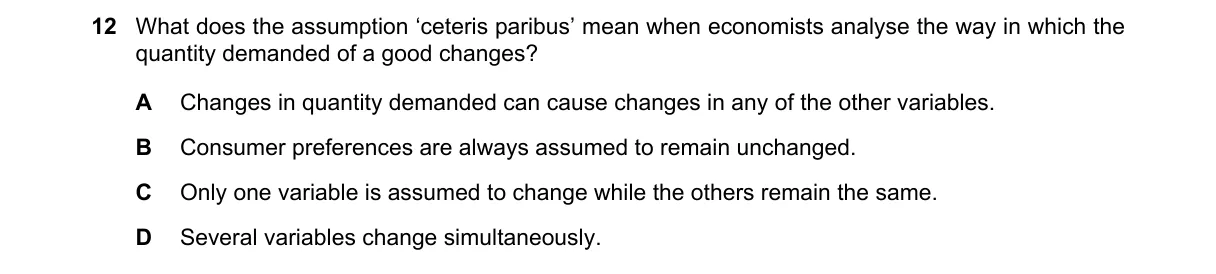
What does the assumption 'ceteris paribus' mean when economists analyse the way in which the quantity demanded of a good changes?
Answer choices
- AChanges in quantity demanded can cause changes in any of the other variables.
- BOnly one variable is assumed to change while the others remain unchanged.
- CConsumer preferences are always assumed to remain unchanged.
- DSeveral variables change simultaneously.
Explanation
Ceteris Paribus in Economic Analysis Steps:
- Define ceteris paribus as "all other things being equal" in economics.
- Identify its role: isolates the effect of one variable, like price, on quantity demanded.
- List key variables held constant: income, consumer preferences, prices of related goods, expectations.
- Match to choices: select the option describing one change with others fixed.
Why B is correct:
- Directly aligns with the definition, allowing analysis of a single variable's impact while holding others constant, as in the law of demand.
Why the others are wrong:
- A: Contradicts ceteris paribus by implying multiple causal links, not isolation.
- C: Too narrow; preferences are one factor held constant, but not the sole or defining assumption.
- D: Opposes the core idea, as simultaneous changes prevent isolating effects.
Final answer: B
Topic: Economic methodology
Practice more A Level Economics (9708) questions on mMCQ.me