A Level Economics (9708)•9708/13/O/N/18
A Level Economics (9708) — 9708/13/O/N/18, Question 30
The government increases interest rates in order to reduce the rate of inflation. What will also result from this action?
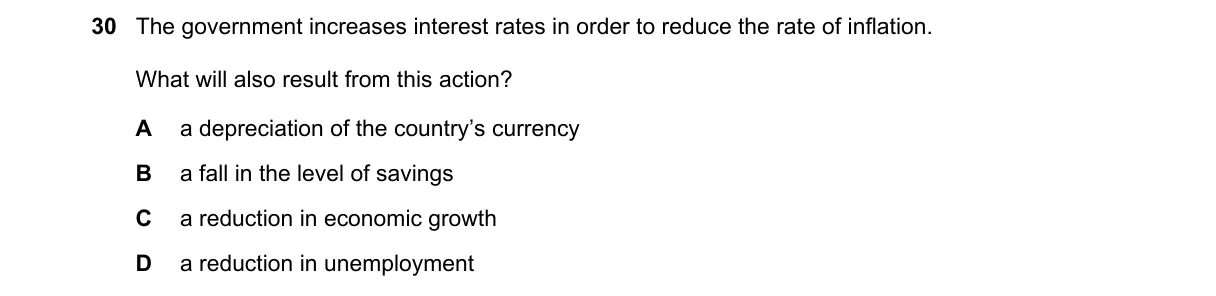
Answer choices
- Aa depreciation of the country's currency
- Ba fall in the level of savings
- Ca fall in the level of economic growth
- Da reduction in unemployment
Explanation
Higher interest rates curb inflation but slow economic activity
Steps:
- Higher interest rates make borrowing costlier, discouraging investment and consumer spending.
- Reduced spending lowers aggregate demand in the economy.
- Lower aggregate demand decreases output and slows economic growth.
- This contractionary monetary policy targets inflation without directly boosting employment.
Why C is correct:
- Contractionary policy reduces aggregate demand, leading to lower GDP growth as per the IS-LM model.
Why the others are wrong:
- A: Higher rates attract foreign capital inflows, causing currency appreciation.
- B: Higher rates incentivize saving by increasing returns on deposits.
- D: Slower growth raises unemployment via the Phillips curve trade-off.
Final answer: C
Topic: Monetary policy
Practice more A Level Economics (9708) questions on mMCQ.me