A Level Economics (9708)•9708/13/O/N/18
A Level Economics (9708) — 9708/13/O/N/18, Question 25
Two countries, Northland and Southland, produce two goods, food and drink. The table shows how many hours each has to use to produce one unit of each product. After specialising according to comparative advantage, they decide to trade. Northland: food 10 hours, drink 4 hours. Southland: food 20 hours, drink 12 hours. Which exchange rate will allow both countries to benefit from trade?
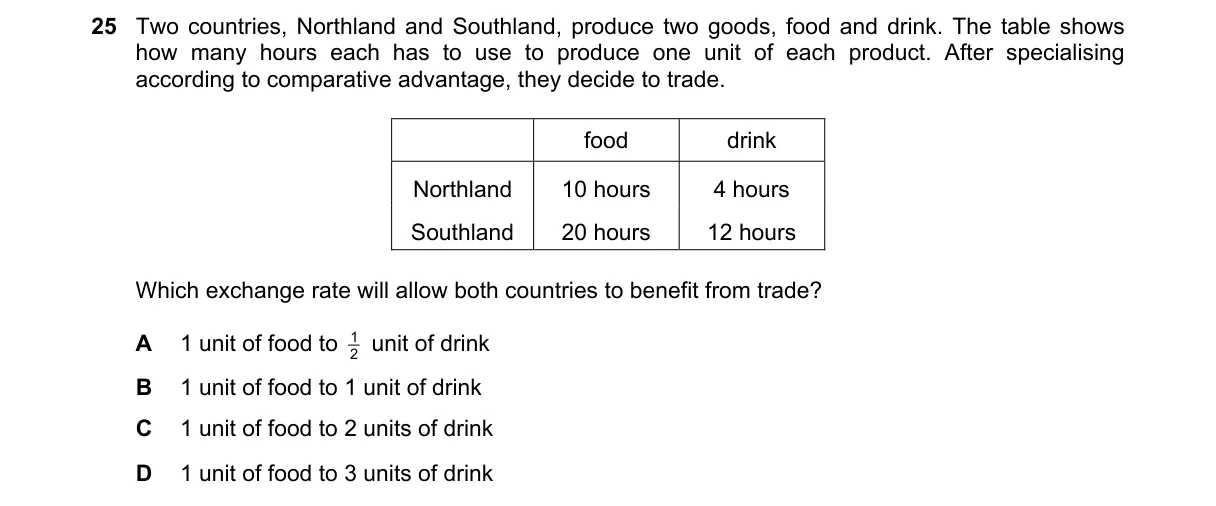
Answer choices
- A1 unit of food to 1 unit of drink
- B1 unit of food to 2 units of drink
- C1 unit of food to 3 units of drink
- D1 unit of food to 3 units of drink
Explanation
Terms of trade based on comparative advantage
Steps:
- Calculate opportunity costs: Northland's 1 food costs 2.5 drinks (10/4); Southland's 1 food costs 1.67 drinks (20/12).
- Determine specialization: Southland has lower opportunity cost for food (1.67 < 2.5), so specializes in food; Northland specializes in drinks.
- Identify beneficial trade range: Exchange rate (drinks per food) must satisfy 1.67 < X < 2.5 for both to gain over autarky.
- Evaluate choices: Only X=2 falls within this range.
Why B is correct:
- 2 drinks per food lies between Southland's (1.67) and Northland's (2.5) opportunity costs, ensuring gains from trade per Ricardo's comparative advantage theory.
Why the others are wrong:
- A: 1 drink per food is below 1.67; Southland gets fewer drinks than autarky, no benefit.
- C: 3 drinks per food exceeds 2.5; Northland pays more than autarky, no benefit.
- D: Same as C; 3 drinks per food exceeds 2.5, no benefit for Northland.
Final answer: B
Topic: The reasons for international trade
Practice more A Level Economics (9708) questions on mMCQ.me