A Level Economics (9708)•9708/13/O/N/18
A Level Economics (9708) — 9708/13/O/N/18, Question 19
An economy is at equilibrium level of real output Y, but wishes to move towards its full employment level of real output Yf. Which combination of policy measures is most likely to achieve this without high inflation?
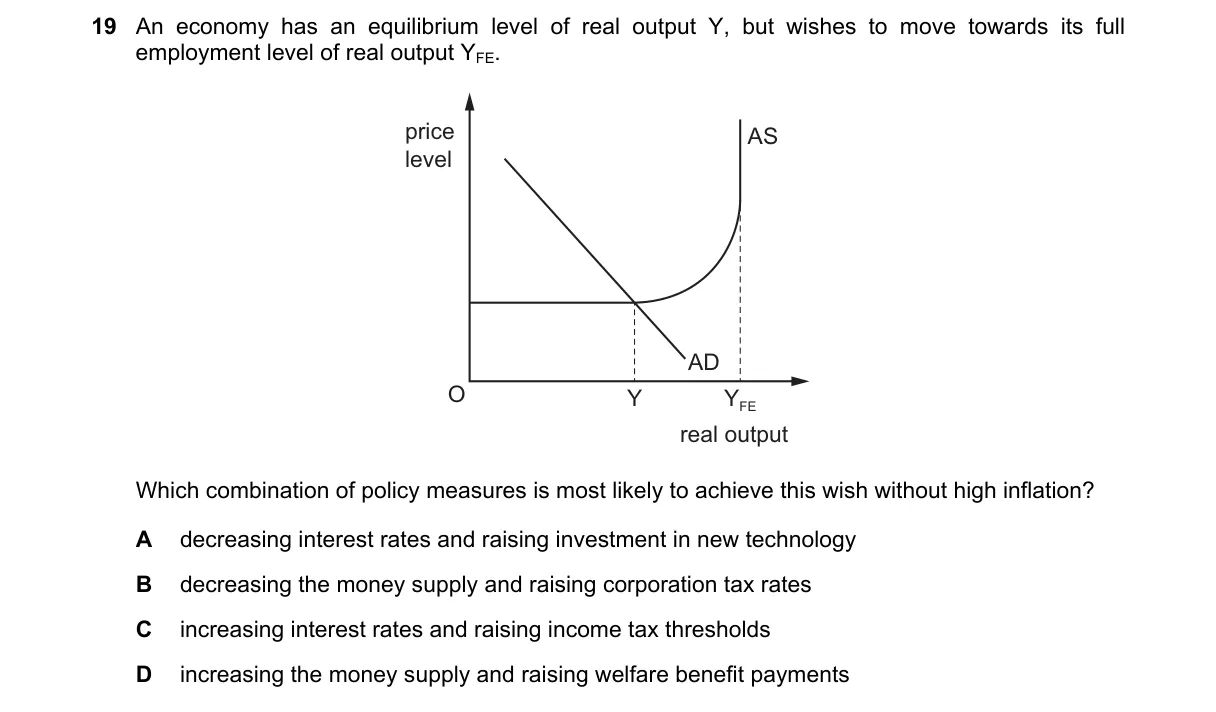
Answer choices
- Adecreasing interest rates and raising investment tax credits
- Bdecreasing money supply and raising corporate tax rates
- Cincreasing interest rates and raising income tax thresholds
- Dincreasing money supply and raising welfare benefit payments
Explanation
Expansionary Monetary and Fiscal Policies to Increase Output
Steps:
- Recognize economy has output gap (Y < Yf), allowing demand stimulus without immediate inflation.
- Identify expansionary policies: lower interest rates boost investment/consumption; tax credits encourage capital spending.
- Evaluate combinations for net AD increase targeting full employment.
- Select option aligning both monetary and fiscal tools for balanced growth.
Why A is correct:
- Decreasing rates (via IS-LM model) shifts LM curve right, lowering borrowing costs; investment tax credits reduce after-tax cost of capital, raising aggregate demand to close gap per AD-AS framework.
Why the others are wrong:
- B: Both actions contract AD—tight money raises rates, higher taxes cut profits/investment—worsening recession.
- C: Higher rates contract AD via reduced borrowing; tax threshold rise mildly expands consumption but net effect likely reduces output.
- D: Expands AD but welfare hikes target consumption without supply incentives, risking demand-pull inflation.
Final answer: A
Topic: Effectiveness of policy options to meet all macroeconomic objectives
Practice more A Level Economics (9708) questions on mMCQ.me