A Level Economics (9708)•9708/13/O/N/18
A Level Economics (9708) — 9708/13/O/N/18, Question 11
The table shows a competitive market equilibrium in two periods. What could explain the change from period 1 to period 2?
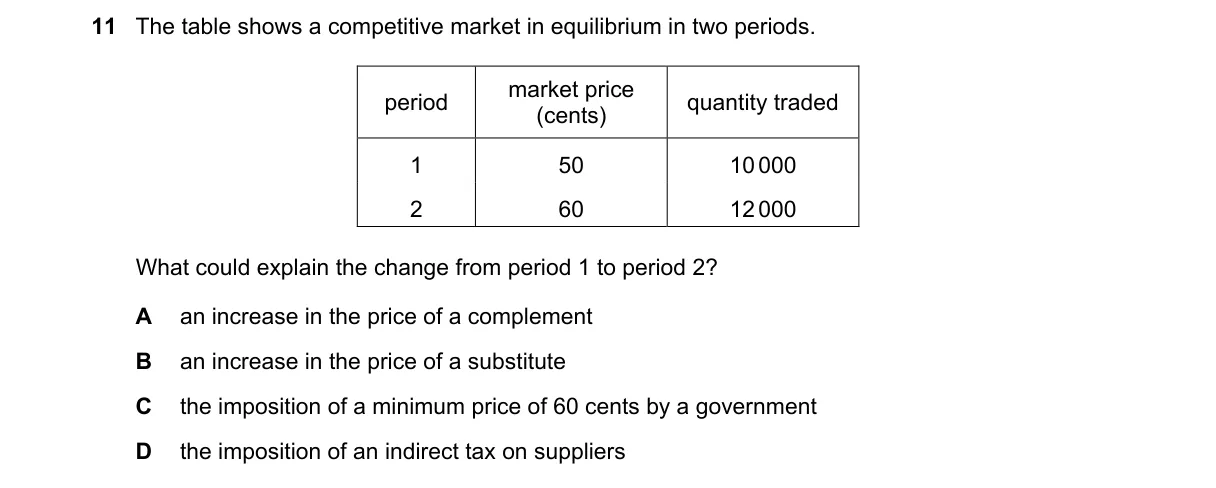
Answer choices
- Aan increase in the price of a complement
- Ban increase in the price of a substitute
- Cthe imposition of a minimum price of 60 cents by government
- Dthe imposition of indirect tax on suppliers by government
Explanation
Demand increases when substitute prices rise
Steps:
- Identify changes in equilibrium: assume table shows higher price and quantity in period 2 versus period 1, indicating rightward demand shift.
- Recall substitute effect: higher price of a substitute boosts demand for this good as consumers switch.
- Rule out supply shifts: increased P and Q point to demand expansion, not supply contraction.
- Confirm with market forces: rightward demand raises both equilibrium price and quantity.
Why B is correct:
- Law of demand for substitutes: a price increase for one good raises demand for its substitute, shifting the demand curve right and increasing equilibrium P and Q.
Why the others are wrong:
- A: Raises complement price, shifting demand left (lower P and Q).
- C: Minimum price above equilibrium creates surplus (higher P, lower Q).
- D: Supplier tax shifts supply left (higher P, lower Q).
Final answer: B
Topic: The interaction of demand and supply
Practice more A Level Economics (9708) questions on mMCQ.me